Arakan Army Detains Five Fishermen with Bangladeshi Trawler off Teknaf Coast

Bay Insight Report

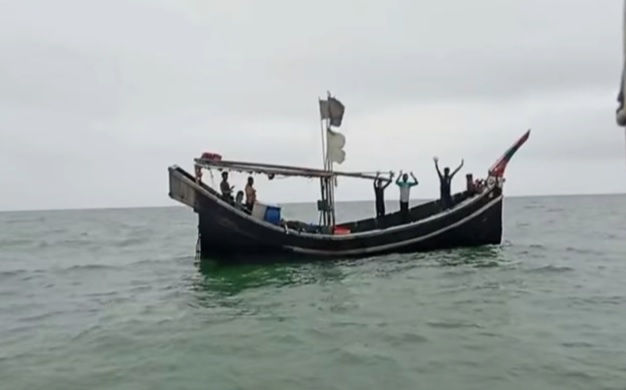
Five fishermen aboard a Bangladeshi fishing trawler were allegedly detained by Myanmar’s armed group, the Arakan Army (AA), while fishing in the Bay of Bengal off the Teknaf coast on Sunday, according to local authorities and fishermen.

The detained fishermen were identified as trawler skipper Salam Nur, 31, Md Ayub, 37, Md Azizullah, 30, Sayed Hossain, 25, and another Md Ayub, 24.

Preliminary information indicates that all five are residents of the Rohingya refugee camps in Ukhiya and Teknaf.

Abul Kalam, General Secretary of the Kayukhali Ghat Fishing Boat Owners’ Association under Teknaf Municipality, said the fishermen were taken away while fishing near the coast, triggering fear among local fishing communities.

According to local fishermen, the trawler, owned by Ali Ahmad of Ali’r Dail village in Sabrang Union, left Kayukhali Ghat on Sunday morning for fishing. When it reached waters near Chera Dwip, members of the Arakan Army allegedly chased and intercepted the vessel before taking the trawler and its five crew members away.

Several nearby fishing trawlers managed to flee the area and return safely, they said.

Teknaf Upazila Nirbahi Officer S M Anik Chowdhury confirmed that the administration had received reports of the incident.

“Preliminary information indicates that all five are residents of Rohingya refugee camps. We are verifying the information and maintaining communication with the relevant authorities,” he said.

Arakan Army’s Version

Meanwhile, the Arakan Army issued a statement claiming that its Coast Guard Security Force detained the five Bangladeshi fishermen for allegedly entering Arakan’s territorial waters and engaging in illegal fishing.

According to the statement, Coast Guard personnel spotted a “suspicious motorized fishing boat” operating in the waters between Kyauk Pandu and Gyin Taw villages in Maungdaw Township on the afternoon of June 28. The statement alleged that the vessel attempted to flee after being signaled to stop for inspection.

The Arakan Army claimed that its Coast Guard pursued the trawler and seized it at around 1:40 pm, approximately 2.7 kilometres southwest of the mouth of Gyin Taw Creek, detaining the five Bangladeshi fishermen.

The Arakan Army maintained that the fishermen had been operating illegally inside Arakan territorial waters.

The Bangladeshi authorities have not independently verified the Arakan Army’s claim regarding the location of the incident, and efforts are underway to establish the exact circumstances surrounding the detention.

7 Bangladeshi Fishermen Detained by Arakan Army in Teknaf

Bay Insight Report

Seven Bangladeshi fishermen, along with two engine-powered fishing boats, were detained by Myanmar’s armed group, the Arakan Army, while fishing in the Bay of Bengal and the Naf River estuary off Teknaf in Cox’s Bazar.

The incident occurred around 9:00 am on Monday in waters adjacent to Shah Porir Dwip. Teknaf Upazila Nirbahi Officer (UNO) S.M. Anik Chowdhury confirmed the incident at around 5:00 pm.

He said the administration learned of the matter through the Coast Guard and has contacted the families of the detained fishermen. Initial information confirmed that seven fishermen had been taken away.

“The fishermen mistakenly entered Myanmar waters and were detained. The BGB, Coast Guard and local administration are working in coordination to bring them back to Bangladesh as quickly as possible,” he said.

Abdul Mannan, a member of Ward No. 7 of Shah Porir Dwip Union, said the fishermen were detained near Myanmar’s Naikhyongdia area, at the estuary of the Naf River and the Bay of Bengal, about six kilometres southeast of the border area under the jurisdiction of the Shah Porir Dwip BOP of Border Guard Bangladesh (BGB)-2.

Local fishermen said the group had gone fishing from the South-East Para ghat of Shah Porir Dwip using two engine-powered fishing boats. While returning after fishing, they unintentionally crossed into Myanmar waters, where members of the Arakan Army detained them.

The detained fishermen were identified as Faisal, 26, Jalil, 16, Azam, 12, Helal, 11, Lalya, 19, Syed Alam, 21, and another Faisal, 22. All are residents of Shah Porir Dwip in Teknaf.

The two fishing boats belong to Md Razzak, 40, of Konapara in Shah Porir Dwip, according to local sources.

Local residents alleged that Bangladeshi fishermen fishing in the border areas of the Naf River and in the Bay of Bengal frequently face harassment and detention by various armed groups. They urged the authorities to ensure the safe and swift return of the detained fishermen.

Mother, daughter allegedly gang-raped in Cox’s Bazar: case filed, huntfor suspects ongoing

Cox’s Bazar । Bay Insight

A case has been filed in connection with the alleged gang rape of a 40-year-old mother and her 15-year-old daughter at their home in Cox’s Bazar’s newly-formed Matamuhuri upazila, as police continue their hunt for the prime suspect and remaining accused.

The incident occurred at around 2:30am on Tuesday in the Dolnighona area, when a gang of eight to ten armed men broke into the family home by cutting through a window grille. The victims’ husband and father was away in Chattogram on business at the time. A five-year-old child, the younger daughter of the family, was also present in the house during the attack.

Quoting family members, Abhijit Das, Assistant Superintendent of Police for the Chakaria Circle, said the gang looted gold jewellery and cash before sexually assaulting both the mother and her teenage daughter, and then fled the scene.

Chakaria Police Station Officer-in-Charge (OC) Md. Monir Hossain confirmed that the victim herself — the mother — filed the case after midnight on Wednesday, following treatment at Cox’s Bazar Sadar Hospital. The case names seven identified suspects and includes five to six unidentified people as accused.

Of the six men detained on Tuesday, five are named in the case as accused. The sixth, Rezaul Karim (36), was produced before the court as a suspect, as his name does not appear in the case. All six have been produced before the Chakaria Senior Judicial Magistrate Court.

The six detained individuals are: Rezaul Karim (36), brothers Tofazzal Hossain alias Babu (23) and Kefayat Hossain alias Puittya (27), Mohammad Tanzid (24) — all from the Dolnighona area of Matamuhuri upazila — Mehedi Hasan (24) of Kaddachara in Saharabil union, and Mohammad Tareq (26) of Koralkhali area.

The family has repeatedly named a locally feared criminal identified only as Jisan as a key figure behind the attack. However, he remains at large since the incident. OC Monir Hossain confirmed that Jisan has also been named in the case.

ASP Abhijit Das had earlier disclosed that Jisan was released from jail just five days before the attack, where he had been serving time on weapons and robbery charges. He described several of those involved in the attack as hardened criminals.

OC Monir Hossain said operations are ongoing to arrest the remaining suspects, and efforts are underway to identify the unidentified accused. Family members have alleged that the same criminal group had targeted their household on two to three previous occasions.

Robbery and gang rape in Cox’s Bazar: Womanand her daughter among victims

Cox’s Bazar । Bay Insight

A horrifying incident of armed robbery followed by gang rape has taken place in the newly formed Matamuhuri Upazila, where a mother and her teenage daughter were sexually assaulted after criminals looted gold ornaments and cash from their home.
Police have confirmed that both victims are currently receiving treatment at Cox’s Bazar Sadar Hospital.

The incident occurred around 2:30am on Tuesday (June 9) in the Dolnighona area of Sikdarpara, under East Borobheola Union of the upazila.

Police have so far arrested six individuals in connection with the case.
The arrestees are: Rezaul Karim (36), Tofazzal Hossain alias Babu (23) and his brother Kefayat Hossain alias Puittya (27), Mohammad Tanzid (24) — all from the Dolunighona area of Matamuhuri Upazila — Mehedi Hasan (24) from the Kaddachara area of Saharbil Union, and Mohammad Tareq (26) from the Koralkhali area.

Quoting members of the victims’ family, Assistant Superintendent of Police (Chakaria Circle) Abhijit Das said that a gang of eight to 10 armed criminals cut through the window grille of the house and forced their way inside. They looted cash, gold jewellery and other valuables before gang-raping the expatriate worker’s wife, aged 40, and her daughter, aged 15, and then fleeing the scene. A five-year-old child of the woman was also present in the house during the attack.
The husband of the woman lives in Chattogram for business purposes.

The critically injured mother and daughter were first taken to Chakaria Upazila Health Complex. As their condition deteriorated, they were transferred to Cox’s Bazar Sadar Hospital for advanced medical care.

After inspecting the scene, the ASP confirmed that an organised local criminal network was responsible for the attack. Family sources claim the same group had targeted this family on multiple previous occasions.

One of those involved in the attack had been arrested by police just days earlier carrying weapons and was already a defendant in robbery and arms cases. That individual, identified as Jisan, had been released from jail only five days before the attack. Several members of the gang are described by police as hardened repeat offenders.

Following the incident, local residents and law enforcement jointly cordoned off the entire area. The six arrests were made during an operation conducted from dawn through the morning on Tuesday.

The uncle of the teenage victim told journalists that his sister and his tenth-grade niece had been subjected to brutal assault by the local criminal gang. The niece’s condition remains critical — doctors are keeping her under intensive care due to severe blood loss.

He further said that this criminal group had attacked their family two to three times previously, and that several members — including Jisan and his brother — are among the most dangerous and notorious offenders in the area.

Contacted, Cox’s Bazar Sadar Hospital’s Residential Medical Officer (RMO) Dr. Subaktabin Sohel said the mother and daughter were admitted to One Stop Crisis Centre (OCC) of the hospital.

After completing necessary diagnosis and treatment, they were discharged from the hospital in the afternoon. The physical condition of the girl was stable, he said.

Four sentenced to death, nine to life in Lt Tanzim murder case

Bay Insight, Cox’s Bazar

A court in Cox’s Bazar has sentenced four accused to death and nine others to life imprisonment in the widely discussed murder case of Bangladesh Army officer Lieutenant Tanzim Sarwar Nirjon.

Five accused were acquitted in the case.

The verdict was delivered on Wednesday afternoon by Judge Mohammad Abul Mansur Siddiqui of the Additional District and Sessions Judge (Fifth) Court in Cox’s Bazar.

Those sentenced to death are Md Helal Uddin, Nurul Amin, Md Nasir Uddin and Morshed Alam. Among them, Morshed Alam remains absconding. All are residents of Dulahazara union in Chakaria upazila.

The verdict drew significant attention at the courthouse, ending nearly one year and eight months of legal proceedings in one of the country’s most talked-about criminal cases.

Following the judgment, chief prosecutor Mohammad Jahangir said the young army officer had fallen victim to a brutal killing while carrying out his duty in service of the country.

“His family, the Bangladesh Army, the state and the people all expected justice to be ensured,” he said.

He added that the court had not relied solely on allegations or one-sided testimonies. Instead, it examined witness statements, evidence, surrounding circumstances and the overall facts of the case before delivering what he described as an exemplary punishment for four of the accused.

Another prosecution lawyer, Ahsan Sezan, said the atmosphere in the dock remained calm after the verdict, although the expressions and behaviour of the accused reflected “a visible sense of guilt”.

“Lieutenant Tanzim was a patriotic officer. He went there to protect people’s lives and property and to ensure public security. But he was brutally killed in the situation that unfolded,” he said.

He said verdicts in both the murder and Arms Act cases were delivered on Wednesday. Alongside the death sentences and life terms, 13 accused were also handed an additional 10 years in prison under sections 399 and 402 of the Penal Code.

Sezan said the prosecution was “reasonably satisfied” with the judgment. He noted that the judge had highlighted issues of social justice, public safety and discipline in his observations.

“The court also stressed that while ensuring punishment for the real offenders, it must equally ensure that no innocent person is convicted,” he added.

He further said the verdict was delivered after considering both the prosecution’s evidence and the defence’s cross-examinations. The full judgment regarding the five acquitted accused would be reviewed and further legal steps could be taken if necessary.

Meanwhile, several defence lawyers said they had been denied justice and would challenge the verdict before the High Court.

Tahsin Sifat, lawyer for the fifth and sixth accused, said they were dissatisfied with the ruling, particularly the life sentences and separate punishments under the Arms Act imposed on his clients.

“We believe they have been deprived of justice. Therefore, we will appeal against the verdict before the higher court,” he said.

Lieutenant Tanzim Sarwar Nirjon, 23, was killed around 1:30am on Sept 23, 2024 while conducting an anti-robbery operation in the East Maizpara area of Dulahazara union in Chakaria.

Originally from Tangail, Tanzim had been commissioned from the Bangladesh Military Academy in 2022 and was serving in the Army Service Corps. His killing triggered nationwide outrage and mourning.

Two days after the incident, Senior Warrant Officer Abdullah Al Harunur Rashid filed a murder case against 17 people over the killing and alleged robbery preparations. In a separate case, Chakaria Police Station Sub-Inspector Alamgir Hossain filed charges under the Arms Act.

Later, Chakaria Police Station Inspector (Investigation) Arup Kumar Chowdhury was assigned to investigate the cases.

After completing the investigation, police submitted charge sheets against 18 people in the two cases. Several individuals named in the original complaint were dropped due to lack of evidence, while new accused were added based on the findings of the investigation.

Dozens feared dead as Malaysia-bound trafficking boat capsizes near Andaman Islands

Bay insight | Cox’s Bazar

A humanitarian catastrophe is feared after a Malaysia-bound trawler carrying more than 250 trafficked Bangladeshis and Rohingya capsized near the Andaman Islands.

The incident came to light after nine survivors were rescued. The Bangladesh-flagged vessel MT Meghna Pride found them floating at sea and later handed them over to the Bangladesh Coast Guard.

Survivors described harrowing accounts of human trafficking and the deadly incident.

Rohingya survivor Rafiqul Islam said he was lured with a job offer from Kutupalong Bazar on April 2 and taken to a house in Rajarchhara area of Teknaf’s Kachhopia union, where he was held with 20–25 others in inhumane conditions. He said they were subjected to severe abuse whenever they tried to leave, and many houses in the area were used to
detain trafficked victims.

On April 4 night, they were taken from the Marine Drive adjacent coast near Rajarchhara and boarded onto small fishing boats. At one point, they were forced to hide in the bush when a Border Guard Bangladesh patrol vehicle passed. They were later transferred in stages to a larger fishing trawler near Myanmar waters, close to Saint Martin’s Island.

More people were loaded onto the vessel, bringing the total to around 280, including 13 crew members and traffickers, 21 Rohingya women, and four children. About 150 of the passengers were Rohingya, while the rest were Bangladeshis.

After leaving the sea near Shamila on April 4, the trawler reached near the Andaman Islands on April 8. Due to rough seas, traffickers forced passengers into four cramped storage compartments meant for fish and nets. Around 25 to 30 victims reportedly died from
suffocation and overcrowding. Survivors said traffickers threatened to sink the trawler if those on deck refused to move into the compartments. Eventually, the vessel capsized after being hit by large waves.

Rafiqul said he survived by clinging to a two-litre water bottle, while he could not say what happened to the others. He was rescued along with eight others on April 9 by a Bangladesh-flagged ship.

Another survivor, Md Imran from Kutupalong Rohingya camp, said he joined the journey hoping to escape camp life. “When we reached near the Andaman Sea, the trawler sank. I held onto a water tank and fought for my life for two days before being rescued by a Bangladeshi ship,” he said. “I still cannot process how many people died. Living with this memory is extremely painful. I am still unwell and have returned home through a court order.”

The Coast Guard has filed a case under the Human Trafficking Prevention and Suppression Act with Teknaf Model Police Station.

According to the case statement, the victims were being transported illegally to Malaysia on a boat named “Tanjina Sultana” when it sank due to adverse weather.

Officer-in-Charge Saiful Islam of Teknaf Model Police Station said the nine rescued individuals were brought to the station. Legal action has been taken against six traffickers, and three victims have been sent home through court orders after initial questioning.

Among the rescued, six are Bangladeshi nationals and three are Rohingya.

He said the recured persons are not telling clearly what happened to the trawler and how they were floating the sea.

“We don’t figure out how many people were there on the sinking boat”, he said. At one stage he refused to talk to this correspondent.

On the other hand, Bangladesh Coast Guard media officer Lieutenant Commander Sabbir Alam Sujan in a press release, said the vessel MT Meghna Pride, en route from Chattogram to Indonesia, rescued nine people — eight men and one woman — from the deep sea near the Andaman Islands on April 9 afternoon. They were later handed over at midnight to the Coast Guard patrol ship Mansur Ali.

The rescued individuals were identified as Md Imran, Rahela Begum, Hridoy, Sohan Uddin, Md Akbar, Rafiqul Islam, Tofayel, Sayad Alam, and Md Hamid.

Cries Across Teknaf: “Where is My Son?”

Abdur Rahman, Teknaf | Cox’s Bazar

On the coast of Cox’s Bazar, the waves do not always carry water. At times, they bring stories of grief, disappearance, and long, silent waiting. Along the shores of Teknaf, the sound of crashing waves now echoes with the cries of countless mothers asking, “Where is my son?”

In the narrow lanes of Shah Porir Dwip, in open fields at dusk, and along the Naf River—places once filled with children’s laughter, football games, and dreams—uncertainty now casts a shadow.

In Teknaf, nightfall brings more than darkness; it brings fear. Dreams drift away across the sea, while families remain onshore, waiting in endless anxiety and sorrow.

Anas lured into disappearance

Mohammad Anas, a 14-year-old boy from Shah Porir Dwip, was a seventh-grade student at Haji Bashir Ahmed High School. Football was his dream, and that dream led him into darkness.

Local traffickers lured him with promises of playing football abroad. He was later sold to another trafficking group for 40,000 taka and taken onto a boat, allegedly bound for Malaysia.

The last contact with his family came through a phone call. From the other end, a ransom of 300,000 taka was demanded, with threats of killing him if the money was not paid.

The family borrowed money to meet the demand. But even after three months, Anas has not returned.

“We paid the money, but did not get our son back,” said his mother, Shomuda Begum. “They took him away with promises of football. Later they threatened to kill him and took three lakh taka. Still, they have not returned my son. I went to the police, but received no justice.”

The family alleged that the accused traffickers continue to move openly in the area without effective action taken against them.

Shomuda Begum said they paid the money to relatives of a broker named Ibrahim, who is reportedly in Malaysia, through his nephew Faruk. “We paid three lakh taka, but still have not got our son back,” she said, adding that complaints were filed with police and local representatives, but no resolution has come.

Disappeared while playing

Abdur Rahman, from a modest family in North Para of Shah Porir Dwip, lived a normal life filled with laughter and dreams.

One afternoon, he went out to play and never returned.

At first, the family thought he might be with friends. But as hours turned into days, concern turned into fear.

A few days later, a call came from an unknown number. The voice on the other end said he had been trafficked to Malaysia through local brokers.

What followed was a nightmare.

His brother, Abdus Salam, said, “After taking him to Malaysia, they demanded three lakh taka. They threatened to kill him if we did not pay. We are poor people. It is impossible for us to arrange such money.”

Every day now passes in uncertainty for the family—waiting for a call, hoping for any news, staring at the door in anticipation.

Whether Abdur Rahman is still alive remains unknown.

Alarming statistics

According to law enforcement data:

From 2016 to 2025, a total of 3,134 people attempting to go to Malaysia were rescued in Cox’s Bazar.
Most of them were Rohingya.
A total of 115 cases were filed in Ukhiya and Teknaf police stations.
Around 1,100 people were accused.
About 600 traffickers were arrested.

On January 4 this year, the navy rescued 263 victims, including women and children, from the sea southwest of Saint Martin’s Island. Ten members of trafficking groups were detained.

New routes and methods of trafficking

Residents alleged that trafficking activities have recently increased around Gholar Char in Shah Porir Dwip.

According to them, the network operates in several stages.

First, local brokers target teenagers and young men, offering dreams of football careers or better jobs abroad. In some cases, victims are abducted directly while outside their homes.

Second, victims are quickly moved to hidden locations before families can begin searching. They are then taken to remote coastal points where small trawlers are prepared.

Third, under the cover of night, they are transported into deep sea, where they are transferred to larger vessels heading toward Malaysia or Thailand.

Fourth, ransom demands begin. Families said traffickers based abroad call and demand large sums of money. They threaten torture or death if the money is not paid. In some cases, victims’ cries or sounds of abuse are played over the phone to pressure families.

Fifth, even after ransom is paid, many victims never return. Some remain missing, while others are feared dead.

Investigations indicate that both local brokers and an international network are involved. Local recruiters hand over victims to overseas operatives, and ransom money is shared among them.

Families alleged that many of these traffickers have operated for years and remain beyond the reach of law due to local influence.

There are also allegations that many victims are taken by force.

Trafficking through 15 coastal points

At least 15 points in Teknaf are reportedly used regularly for trafficking under the cover of darkness, according to the reporter’s findings. A well-organized network of brokers is said to be involved.

Multiple local sources, intelligence reports, and victim accounts identified several individuals allegedly linked to trafficking networks in Shah Porir Dwip and surrounding areas. Attempts to contact the accused for comment were unsuccessful.

Police response: “Operations ongoing”

Officer-in-Charge Saiful Islam of Teknaf Model Police Station said, “Human trafficking is an international crime. We are highly active in preventing it. Regular operations are ongoing, and several suspects have already been arrested.”

He added that recent information about boats heading to Malaysia is being verified, and surveillance in coastal areas has been strengthened.

Waiting in despair

An invisible fear now grips the coast of Teknaf. Just as waves return to the shore, will the lost sons return home?

Anas’s mother still waits at the door, startled by every sound, hoping it might be her son returning. But as time passes, that hope fades.

A simple temptation, a single call—“Will you go abroad to play?”—and boys like Anas disappear.

Those small steps that left home never return. Calls come, demands come, fear comes—but the person never comes back.

No structured mental health services for Cox’s Bazar locals; over 250,000 Rohingya received support in eight years

Bay Insight | Cox’s Bazar

On the occasion of World Health Day, a report by Bay Insight revealed a concerning picture of mental health services in the Rohingya refugee camps in Cox’s Bazar. From 2018 to February 2026, more than 240,000 Rohingya received individual counselling, while over 43,000 patients sought treatment from psychiatrists, according to data from the Médecins Sans Frontières (MSF), which provides healthcare services to Rohingya refugees in Bangladesh.

Health workers said the demand for mental health services among Rohingya continues to rise due to violence, displacement, and prolonged stress of camp life.

However, in contrast to this progress, there is no structured government mental health service or specialist doctor available for the local population in Cox’s Bazar, highlighting a worrying gap.

Rising demand at the start of the year

In January and February this year alone, 7,616 people received individual mental health counselling, while 3,593 sought psychiatric consultation in the camps.

Although the services are open to both Rohingya and host communities, the majority of patients are Rohingya.

A field-level counsellor, requesting anonymity, said, “New patients are coming every day. Many initially think they have physical problems, but later it turns out to be psychological.”

Long shadow of trauma

A large number of Rohingya who fled violence in Myanmar’s Rakhine State in 2017 continue to carry deep trauma. Uncertainty in the camps, lack of employment, and insecurity are making their mental health conditions more complex.

A resident of Kutupalong camp, using the pseudonym Rahima Begum, said, “I cannot sleep at night. Memories come back. I am always worried about my children. Sometimes I feel like I am losing my mind.”

Health workers said such experiences are no longer rare, but widespread.

Common mental health conditions

Doctors identified the most common conditions in the camps as depression, anxiety disorders, psychosis, and bipolar mood disorder.

Experts said effective treatment requires not only medication but also regular counselling and psychosocial support.

MSF’s integrated care model

Dr Ashish Kumar Das, Deputy Country Representative (Medical) at MSF, said, “Effective mental healthcare requires a combination of medication and structured counselling. We provide both through our mental health units.”

MSF units are staffed with trained doctors, clinical psychologists, and counsellors, ensuring evidence-based and integrated care.

Limited services for locals

However, mental health services for the local population in Cox’s Bazar remain limited. Superintendent of Cox’s Bazar Sadar Hospital, Mong Tin Nyo, said there is currently no psychiatrist and no dedicated mental health department at the hospital.

He said plans are underway to introduce a separate unit with psychiatrists and counsellors in the near future.

Local resident Jahangir Alam said, “We don’t even know where to go if we face mental health issues. Having such services in government hospitals would help us a lot.”

Challenges ahead

While progress in mental health services in the Rohingya camps is notable, many people still remain outside treatment. At the same time, the lack of adequate services for the host community remains a major challenge.

The situation in Cox’s Bazar highlights one clear message on World Health Day: mental healthcare is now an essential part of humanitarian response, especially for displaced and vulnerable populations.

Teknaf Land Port Reopens After Nearly a Year, Concerns Persist Over Security and Trade Conditions

Bay Insight | Cox’s Bazar

After remaining largely inactive for nearly a year, operations at Teknaf Land Port have been officially resumed following an announcement by State Minister for Shipping, Mohammad Rajib Ahsan.
However, despite the government’s decision, stakeholders have expressed concerns over security, river routes, and the practical realities of cross-border trade.

During a visit to the port on Monday (April 6), the minister said the decision to resume operations was made in response to public demand and after discussions with all relevant parties. “We have decided to restart the port’s activities from today,” he said.

He added that security would be ensured through coordinated efforts by the port authority, customs, Coast Guard, Border Guard Bangladesh (BGB), and other law enforcement agencies. Measures would also be taken to prevent the involvement of Rohingyas in port activities.

Despite the announcement, business representatives who attended the meeting said the situation on the ground is far from straightforward.

Abed Ahsan Sagar, a former director of the Cox’s Bazar Chamber of Commerce and Industry, told that security concerns were the main reason behind the prolonged suspension. “We felt that objections from security agencies, particularly BGB and the Coast Guard, played a key role. Their stance was largely negative,” he said.

According to him, the concerns include potential smuggling through the port, misuse of certain goods such as cement and rods, and broader risks linked to the border situation.

He also said discussions were held about installing security posts inside the port, a proposal opposed by business leaders due to the port’s existing legal framework.

A key proposal raised during the meeting was the installation of scanners to monitor goods. “The minister said scanners would be installed so that goods can be verified during loading and unloading. BGB can carry out inspections at gates or checkpoints if needed,” Sagar said.

However, despite the official reopening, trade activities have yet to resume.

Jasim Uddin, the port’s general manager, said the port was already operational in principle. “We are ready. Once goods start arriving, operations will begin. Only then will the real situation become clear,” he said.

Complicating matters further is the situation in Myanmar’s Rakhine State. Since December 2024, the Arakan Army has taken control of large parts of the region and established influence over the Naf River, leading to allegations of extortion targeting cargo vessels.

Business leaders said simply reopening the port will not resolve these issues.

Sagar said vessels often need to pass through Myanmar waters, forcing traders to pay various groups. “If dredging is carried out, an alternative route could be created, reducing these risks,” he said, warning that without it, the port may become inactive again.

Traders also claimed that a significant amount of money remains stuck with Myanmar businessmen “Around $9 million is held in draft form. Once goods start moving, this can be adjusted,” Sagar said.

Abu Morshed Chowdhury Khoka, a former president of the Cox’s Bazar Chamber, welcomed the decision, saying it would benefit traders by allowing cheaper imports of essentials like onions, ginger, and garlic, while also boosting government revenue.

However, he noted that the responsibility of sending goods lies with traders on the Myanmar side. “We don’t deal with the Arakan Army, we deal with the businessmen across the border,” he said.

Meanwhile, the commanding officer of Teknaf 2 BGB Battalion Lt Col Hanifur Rahman said they remain within the scope of the minister’s directives. “Security issues have been discussed and necessary steps are being taken,” he said, adding that strengthening internal security structures is underway.

Cross-border trade between Bangladesh and Myanmar began in 1995, and Teknaf Land Port was officially inaugurated on November 5, 2003, on 27 acres of land.

However, import activities effectively came to a halt after April 13, 2025, when the last timber-laden trawler arrived.

Although the government’s announcement has reopened the door, the pace of normalization in trade will depend on border security, navigability of river routes, and the situation in Myanmar.

Rakib’s presence found in location data in Khorshed murder case, investigation takes new turn

Bay Insight | Cox’s Bazar

Police have raised questions over statements made by the prime accused, Tarek, in the widely discussed murder case of Khorshed Alam, a student activist known as a “July fighter” and a member of Jatiyatabadi Chhatra Dal.

An official involved in the investigation said Tarek told police he saw co-accused Rakib and several others at the scene during the incident.

The officer questioned the claim, saying, “If he was not involved, how did he see others at the scene? Did he observe it from a distance with binoculars?

Investigators said technological analysis has provided a key breakthrough. According to officials, Rakib’s presence near the crime scene on the day of the incident has been confirmed through mobile phone location data and other digital trails. They said this information has added a new dimension to the investigation and is being treated as a vital lead in verifying his possible involvement.

Law enforcement officials said the probe is currently focused on two suspects. “Two individuals have been arrested on suspicion, and there are initial indications of their involvement,” a police official told Bay Insight, adding that the probe appears to be on the right track and is being examined further.

Investigating officer Chinmoy Barua said Tarek was arrested within 12 hours of the incident, while Rakib was detained from court premises when he surrendered in a separate case. However, neither has yet been taken on remand, and police plan to seek remand soon for further questioning.

Investigators are also examining relationships and communication patterns among those involved. A woman identified as Tarin is being discussed due to her prior contact with the victim, although no evidence of her involvement has been confirmed so far. An official said Khorshed had called Tarin before the incident.

CCTV footage from before and after the incident is being analyzed, though officials said not all details can be disclosed at this stage. Footage reviewed by Bay Insight shows Tarek near Hotel Prasad Paradise at Sugandha Point around 9:30 pm on the night of the incident. However, no footage has been found after that time, with hotel authority saying the relevant footage was deleted.

Local businessmen said Tarek was playing Ludo there for some time, though none could specify the exact duration.

A roommate of Tarek gave a different account, saying Tarek returned home after securing bail in another case, freshened up, and even danced before going out again later. He said they later went to Sugandha Point, where Tarek sat down to play Ludo with friends. The roommate claimed he later found Tarek missing and was told over the phone that he had returned home.

He also said, some members of a group known locally as ‘Fakir Group’ arrived on motorcycles looking for Tarek.

Tarek’s mother, however, claimed her son is innocent. She said he returned home after playing Ludo, ate dinner, and went to sleep. According to her, he later traveled from Cox’s Bazar to their home in Ramu that night.

Police said they are also reviewing previous criminal records of the suspects. “This group has a history of various criminal activities. Their record is not good,” an officer said.

Officials said preliminary findings suggest involvement of the arrested individuals, but no final conclusion has been reached. “Everything indicates they may be involved, but the investigation is ongoing,” an official said.

Khorshed Alam was stabbed to death around 10:30 pm on March 24 at Kabita Square in Cox’s Bazar town. He was rushed to Cox’s Bazar Sadar Hospital, where doctors declared him dead.

Police said a group of attackers surrounded and stabbed him. Tarin, who was with the victim at the time, told journalists that a group of miscreants demanded valuables before the attack, and Khorshed was stabbed following an allegation involving an attack on a person named Arif.

Officer-in-Charge Chomiuddin of Cox’s Bazar Sadar Model Police Station said witnesses and close associates of the victim are being questioned, and efforts are ongoing to identify and arrest those involved.