
Arakan Army Detains Five Fishermen with Bangladeshi Trawler off Teknaf Coast

Bay Insight Report

Five fishermen aboard a Bangladeshi fishing trawler were allegedly detained by Myanmar’s armed group, the Arakan Army (AA), while fishing in the Bay of Bengal off the Teknaf coast on Sunday, according to local authorities and fishermen.

The detained fishermen were identified as trawler skipper Salam Nur, 31, Md Ayub, 37, Md Azizullah, 30, Sayed Hossain, 25, and another Md Ayub, 24.

Preliminary information indicates that all five are residents of the Rohingya refugee camps in Ukhiya and Teknaf.

Abul Kalam, General Secretary of the Kayukhali Ghat Fishing Boat Owners’ Association under Teknaf Municipality, said the fishermen were taken away while fishing near the coast, triggering fear among local fishing communities.

According to local fishermen, the trawler, owned by Ali Ahmad of Ali’r Dail village in Sabrang Union, left Kayukhali Ghat on Sunday morning for fishing. When it reached waters near Chera Dwip, members of the Arakan Army allegedly chased and intercepted the vessel before taking the trawler and its five crew members away.

Several nearby fishing trawlers managed to flee the area and return safely, they said.

Teknaf Upazila Nirbahi Officer S M Anik Chowdhury confirmed that the administration had received reports of the incident.

“Preliminary information indicates that all five are residents of Rohingya refugee camps. We are verifying the information and maintaining communication with the relevant authorities,” he said.

Arakan Army’s Version

Meanwhile, the Arakan Army issued a statement claiming that its Coast Guard Security Force detained the five Bangladeshi fishermen for allegedly entering Arakan’s territorial waters and engaging in illegal fishing.
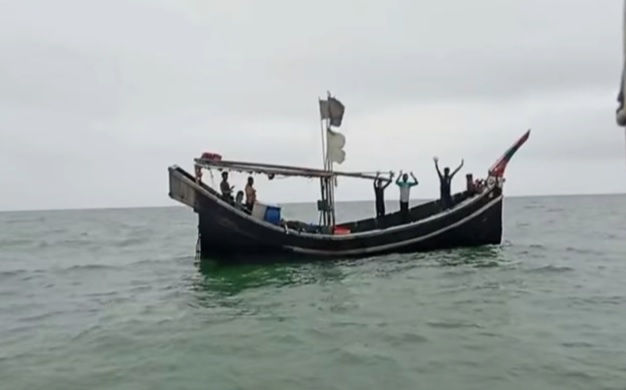
According to the statement, Coast Guard personnel spotted a “suspicious motorized fishing boat” operating in the waters between Kyauk Pandu and Gyin Taw villages in Maungdaw Township on the afternoon of June 28. The statement alleged that the vessel attempted to flee after being signaled to stop for inspection.

The Arakan Army claimed that its Coast Guard pursued the trawler and seized it at around 1:40 pm, approximately 2.7 kilometres southwest of the mouth of Gyin Taw Creek, detaining the five Bangladeshi fishermen.

The Arakan Army maintained that the fishermen had been operating illegally inside Arakan territorial waters.

The Bangladeshi authorities have not independently verified the Arakan Army’s claim regarding the location of the incident, and efforts are underway to establish the exact circumstances surrounding the detention.

Mother, daughter allegedly gang-raped in Cox’s Bazar: case filed, huntfor suspects ongoing

Cox’s Bazar । Bay Insight

A case has been filed in connection with the alleged gang rape of a 40-year-old mother and her 15-year-old daughter at their home in Cox’s Bazar’s newly-formed Matamuhuri upazila, as police continue their hunt for the prime suspect and remaining accused.

The incident occurred at around 2:30am on Tuesday in the Dolnighona area, when a gang of eight to ten armed men broke into the family home by cutting through a window grille. The victims’ husband and father was away in Chattogram on business at the time. A five-year-old child, the younger daughter of the family, was also present in the house during the attack.

Quoting family members, Abhijit Das, Assistant Superintendent of Police for the Chakaria Circle, said the gang looted gold jewellery and cash before sexually assaulting both the mother and her teenage daughter, and then fled the scene.

Chakaria Police Station Officer-in-Charge (OC) Md. Monir Hossain confirmed that the victim herself — the mother — filed the case after midnight on Wednesday, following treatment at Cox’s Bazar Sadar Hospital. The case names seven identified suspects and includes five to six unidentified people as accused.

Of the six men detained on Tuesday, five are named in the case as accused. The sixth, Rezaul Karim (36), was produced before the court as a suspect, as his name does not appear in the case. All six have been produced before the Chakaria Senior Judicial Magistrate Court.

The six detained individuals are: Rezaul Karim (36), brothers Tofazzal Hossain alias Babu (23) and Kefayat Hossain alias Puittya (27), Mohammad Tanzid (24) — all from the Dolnighona area of Matamuhuri upazila — Mehedi Hasan (24) of Kaddachara in Saharabil union, and Mohammad Tareq (26) of Koralkhali area.

The family has repeatedly named a locally feared criminal identified only as Jisan as a key figure behind the attack. However, he remains at large since the incident. OC Monir Hossain confirmed that Jisan has also been named in the case.

ASP Abhijit Das had earlier disclosed that Jisan was released from jail just five days before the attack, where he had been serving time on weapons and robbery charges. He described several of those involved in the attack as hardened criminals.

OC Monir Hossain said operations are ongoing to arrest the remaining suspects, and efforts are underway to identify the unidentified accused. Family members have alleged that the same criminal group had targeted their household on two to three previous occasions.

$710 million aid appeal: As UN warns Rohingyas’ hope of return to Myanmar is fading

Bay Insight, Desk

The United Nations and its partner agencies have appealed for $710.5 million in fresh international assistance to meet the urgent needs of Rohingya refugees and host communities in coordination with the Bangladesh government.

The UN also warned that hopes for the Rohingyas’ early return to Myanmar are fading as conflict continues inside Rakhine State.

The appeal was made on Wednesday during the presentation of the updated 2026 Joint Response Plan (JRP) at the UN building in Dhaka. The plan aims to provide assistance to around 1.56 million Rohingya refugees and host community members living in Cox’s Bazar and Bhasan Char.

According to the UN, growing global instability, conflicts and humanitarian crises are reducing international aid, putting essential services in the Rohingya camps — including food, healthcare, education and protection — at risk.

Bangladesh is currently hosting around 1.2 million Rohingya refugees. Since the beginning of 2024, nearly 150,000 more Rohingyas have entered Bangladesh due to ongoing conflict in Myanmar’s Rakhine State, further increasing pressure on the overcrowded camps.

Under the JRP, the proposed funding includes $247.3 million for food assistance, $128 million for shelter, $61.2 million for water, sanitation and hygiene, $52.7 million for education, $49.9 million for healthcare, and $35.1 million for livelihoods and skills development. Another $36.2 million has been allocated to support affected host communities.

The UN said the international community has provided around $5.42 billion in assistance for the Rohingya crisis from 2017 through the end of 2025, with the United States remaining the largest donor.

Among those speaking at the event were Kelly T. Clements, Deputy High Commissioner of the United Nations High Commissioner for Refugees, Rania Dagash-Kamara, Assistant Executive Director of the World Food Programme, and Nyaradzayi Gumbonzvanda, Deputy Executive Director of UN Women.

Kelly T. Clements said, “At a time when resources are becoming increasingly limited, strengthening refugees’ skills and resilience is more important than ever so they can become self-reliant and maintain hope for the future.”

Rania Dagash-Kamara said Bangladesh had shown “extraordinary generosity” by sheltering the Rohingyas, adding that continued donor support remained a lifeline for the refugees.

Nyaradzayi Gumbonzvanda said the impact of funding shortages had already started affecting daily life in the camps, with women and girls facing heightened risks and violence due to displacement.

According to the UN, around 35 percent of families in the camps are entirely dependent on food assistance, while 42 percent rely on temporary and uncertain income sources. Only 23 percent of households are currently involved in cash-based humanitarian work opportunities.

The UN further warned that ongoing conflict in Rakhine State is dimming prospects for repatriation in the near future, prompting many Rohingyas to attempt dangerous sea journeys to other countries. According to the agency, such journeys became the deadliest in 2025. Last month, a boat carrying more than 270 passengers capsized, with only nine survivors rescued.

Bangladesh Foreign Ministry Secretary (Intergovernmental Organizations) and Acting Foreign Secretary M. Farhadul Islam and interim UN Resident Coordinator Carol Flore were also present at the JRP launch event. A total of 98 humanitarian partners, including 52 Bangladeshi organisations, have endorsed the plan.

The United Nations reiterated that the only sustainable solution to the Rohingya crisis is safe, voluntary and dignified repatriation, adding that continued international support remains essential until conditions in Myanmar become conducive for return.

Four sentenced to death, nine to life in Lt Tanzim murder case

Bay Insight, Cox’s Bazar

A court in Cox’s Bazar has sentenced four accused to death and nine others to life imprisonment in the widely discussed murder case of Bangladesh Army officer Lieutenant Tanzim Sarwar Nirjon.

Five accused were acquitted in the case.

The verdict was delivered on Wednesday afternoon by Judge Mohammad Abul Mansur Siddiqui of the Additional District and Sessions Judge (Fifth) Court in Cox’s Bazar.

Those sentenced to death are Md Helal Uddin, Nurul Amin, Md Nasir Uddin and Morshed Alam. Among them, Morshed Alam remains absconding. All are residents of Dulahazara union in Chakaria upazila.

The verdict drew significant attention at the courthouse, ending nearly one year and eight months of legal proceedings in one of the country’s most talked-about criminal cases.

Following the judgment, chief prosecutor Mohammad Jahangir said the young army officer had fallen victim to a brutal killing while carrying out his duty in service of the country.

“His family, the Bangladesh Army, the state and the people all expected justice to be ensured,” he said.

He added that the court had not relied solely on allegations or one-sided testimonies. Instead, it examined witness statements, evidence, surrounding circumstances and the overall facts of the case before delivering what he described as an exemplary punishment for four of the accused.

Another prosecution lawyer, Ahsan Sezan, said the atmosphere in the dock remained calm after the verdict, although the expressions and behaviour of the accused reflected “a visible sense of guilt”.

“Lieutenant Tanzim was a patriotic officer. He went there to protect people’s lives and property and to ensure public security. But he was brutally killed in the situation that unfolded,” he said.

He said verdicts in both the murder and Arms Act cases were delivered on Wednesday. Alongside the death sentences and life terms, 13 accused were also handed an additional 10 years in prison under sections 399 and 402 of the Penal Code.

Sezan said the prosecution was “reasonably satisfied” with the judgment. He noted that the judge had highlighted issues of social justice, public safety and discipline in his observations.

“The court also stressed that while ensuring punishment for the real offenders, it must equally ensure that no innocent person is convicted,” he added.

He further said the verdict was delivered after considering both the prosecution’s evidence and the defence’s cross-examinations. The full judgment regarding the five acquitted accused would be reviewed and further legal steps could be taken if necessary.

Meanwhile, several defence lawyers said they had been denied justice and would challenge the verdict before the High Court.

Tahsin Sifat, lawyer for the fifth and sixth accused, said they were dissatisfied with the ruling, particularly the life sentences and separate punishments under the Arms Act imposed on his clients.

“We believe they have been deprived of justice. Therefore, we will appeal against the verdict before the higher court,” he said.

Lieutenant Tanzim Sarwar Nirjon, 23, was killed around 1:30am on Sept 23, 2024 while conducting an anti-robbery operation in the East Maizpara area of Dulahazara union in Chakaria.

Originally from Tangail, Tanzim had been commissioned from the Bangladesh Military Academy in 2022 and was serving in the Army Service Corps. His killing triggered nationwide outrage and mourning.

Two days after the incident, Senior Warrant Officer Abdullah Al Harunur Rashid filed a murder case against 17 people over the killing and alleged robbery preparations. In a separate case, Chakaria Police Station Sub-Inspector Alamgir Hossain filed charges under the Arms Act.

Later, Chakaria Police Station Inspector (Investigation) Arup Kumar Chowdhury was assigned to investigate the cases.

After completing the investigation, police submitted charge sheets against 18 people in the two cases. Several individuals named in the original complaint were dropped due to lack of evidence, while new accused were added based on the findings of the investigation.

Dozens feared dead as Malaysia-bound trafficking boat capsizes near Andaman Islands

Bay insight | Cox’s Bazar

A humanitarian catastrophe is feared after a Malaysia-bound trawler carrying more than 250 trafficked Bangladeshis and Rohingya capsized near the Andaman Islands.

The incident came to light after nine survivors were rescued. The Bangladesh-flagged vessel MT Meghna Pride found them floating at sea and later handed them over to the Bangladesh Coast Guard.

Survivors described harrowing accounts of human trafficking and the deadly incident.

Rohingya survivor Rafiqul Islam said he was lured with a job offer from Kutupalong Bazar on April 2 and taken to a house in Rajarchhara area of Teknaf’s Kachhopia union, where he was held with 20–25 others in inhumane conditions. He said they were subjected to severe abuse whenever they tried to leave, and many houses in the area were used to
detain trafficked victims.

On April 4 night, they were taken from the Marine Drive adjacent coast near Rajarchhara and boarded onto small fishing boats. At one point, they were forced to hide in the bush when a Border Guard Bangladesh patrol vehicle passed. They were later transferred in stages to a larger fishing trawler near Myanmar waters, close to Saint Martin’s Island.

More people were loaded onto the vessel, bringing the total to around 280, including 13 crew members and traffickers, 21 Rohingya women, and four children. About 150 of the passengers were Rohingya, while the rest were Bangladeshis.

After leaving the sea near Shamila on April 4, the trawler reached near the Andaman Islands on April 8. Due to rough seas, traffickers forced passengers into four cramped storage compartments meant for fish and nets. Around 25 to 30 victims reportedly died from
suffocation and overcrowding. Survivors said traffickers threatened to sink the trawler if those on deck refused to move into the compartments. Eventually, the vessel capsized after being hit by large waves.

Rafiqul said he survived by clinging to a two-litre water bottle, while he could not say what happened to the others. He was rescued along with eight others on April 9 by a Bangladesh-flagged ship.

Another survivor, Md Imran from Kutupalong Rohingya camp, said he joined the journey hoping to escape camp life. “When we reached near the Andaman Sea, the trawler sank. I held onto a water tank and fought for my life for two days before being rescued by a Bangladeshi ship,” he said. “I still cannot process how many people died. Living with this memory is extremely painful. I am still unwell and have returned home through a court order.”

The Coast Guard has filed a case under the Human Trafficking Prevention and Suppression Act with Teknaf Model Police Station.

According to the case statement, the victims were being transported illegally to Malaysia on a boat named “Tanjina Sultana” when it sank due to adverse weather.

Officer-in-Charge Saiful Islam of Teknaf Model Police Station said the nine rescued individuals were brought to the station. Legal action has been taken against six traffickers, and three victims have been sent home through court orders after initial questioning.

Among the rescued, six are Bangladeshi nationals and three are Rohingya.

He said the recured persons are not telling clearly what happened to the trawler and how they were floating the sea.

“We don’t figure out how many people were there on the sinking boat”, he said. At one stage he refused to talk to this correspondent.

On the other hand, Bangladesh Coast Guard media officer Lieutenant Commander Sabbir Alam Sujan in a press release, said the vessel MT Meghna Pride, en route from Chattogram to Indonesia, rescued nine people — eight men and one woman — from the deep sea near the Andaman Islands on April 9 afternoon. They were later handed over at midnight to the Coast Guard patrol ship Mansur Ali.

The rescued individuals were identified as Md Imran, Rahela Begum, Hridoy, Sohan Uddin, Md Akbar, Rafiqul Islam, Tofayel, Sayad Alam, and Md Hamid.

Which Four Zones Will St. Martin’s Island Be Divided Into?

Cox’s Bazar | Bay Insight

To ensure conservation and sustainable management, a proposal has been prepared to divide St. Martin’s Island, the only coral island of Bangladesh, into four distinct zones. The zoning framework has been outlined in a draft master plan prepared by the Center for Environmental and Geographic Information Services (CEGIS) under the Ministry of Water Resources.

The draft master plan was presented on Tuesday (6 January) at a workshop on the St. Martin’s Master Plan held at a hotel in the capital Dhaka. At the workshop, CEGIS Senior Expert H. M. Nurul Islam highlighted various aspects of the proposed plan.

According to the draft master plan, St. Martin’s Island is proposed to be divided into four zones: General Use Area, Controlled Resource Area, Sustainable Use Area, and Restricted Access Area.

General Use Area: Tourism and Settlement under Conditions

In the General Use Area (Zone 1), residential living, tourism activities, infrastructure development, and limited economic activities will be allowed. However, these activities must be conducted in line with environmentally friendly and sustainable development guidelines.

Activities harmful to the environment such as coral collection, pollution, night fishing using artificial lights, and high-speed vehicle movement are proposed to be prohibited in this zone.

Controlled Resource Area: Protective Buffer for Sensitive Zones

The Controlled Resource Area (Zone 2) has been identified as a buffer zone surrounding environmentally sensitive areas. Limited eco-friendly tourism and economic activities may be permitted here.

However, the draft plan proposes to ban illegal resort construction, deforestation, use of harmful agricultural chemicals, and collection of turtle eggs. Restrictions are also proposed on using lights or lighting fires on boats at night.

Sustainable Use Area: Nature Conservation Zone

In the Sustainable Use Area (Zone 3), human intervention is recommended to be kept to a minimum. No new settlements, infrastructure development, or environmentally altering activities will be allowed.

Mangrove forests, lagoons, and turtle nesting sites will fall under this zone and receive special protection. Public access will be limited, and high-speed vehicle movement will be prohibited.

Restricted Access Area: Strictest Conservation Measures

The strictest regulations are proposed for the Restricted Access Area (Zone 4). Following the International Union for Conservation of Nature (IUCN) standards for a “Strict Nature Reserve,” this zone is planned to be developed as a fully protected area.

Public access will be almost entirely prohibited. Activities such as settlement, resource extraction, fishing within 1,000 meters, causing pollution, or disturbing wildlife are proposed to be strictly banned.