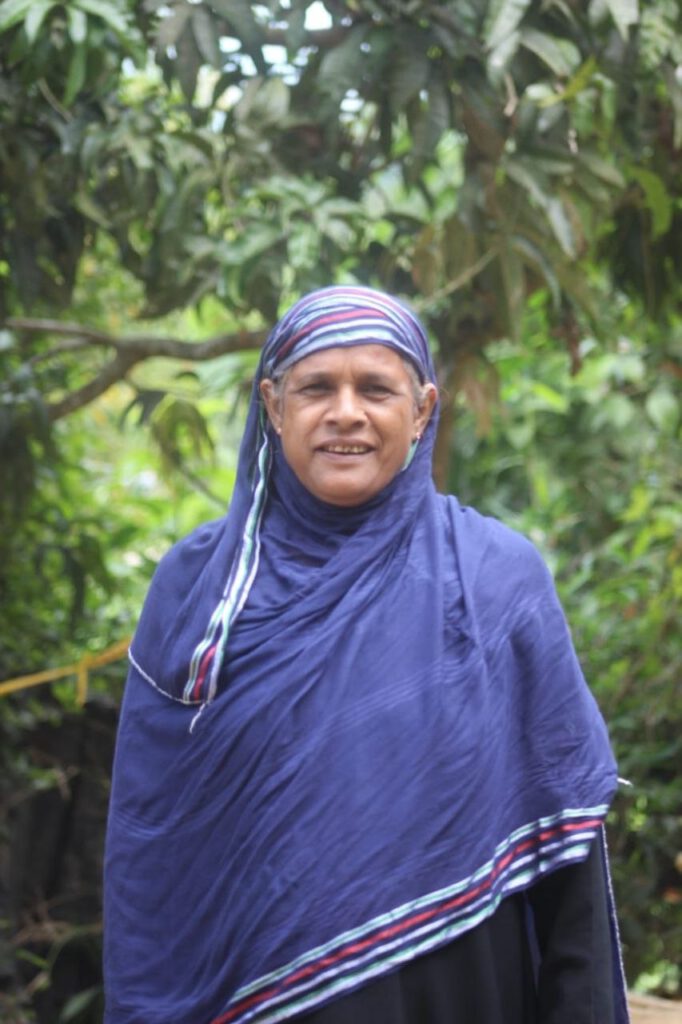
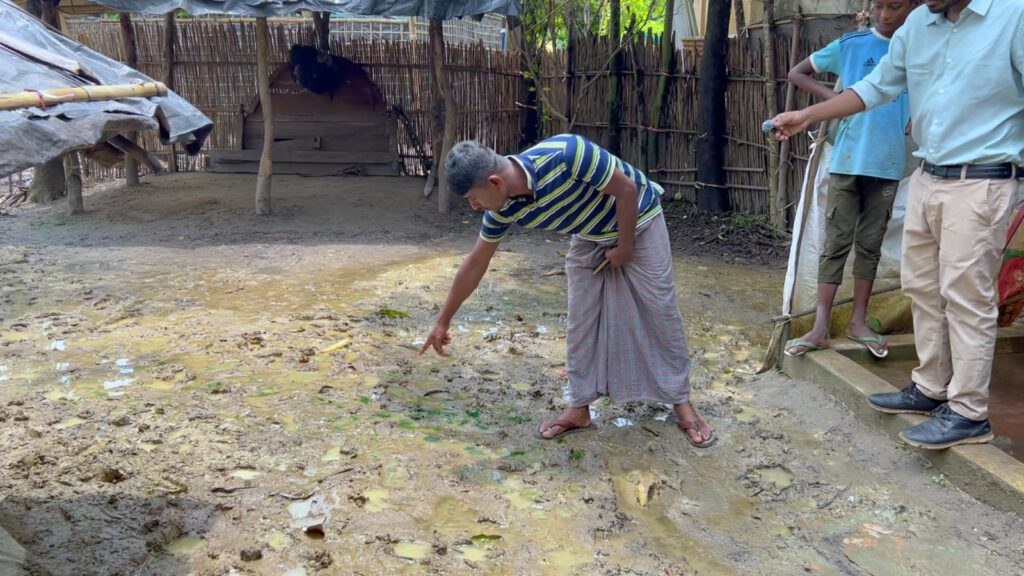
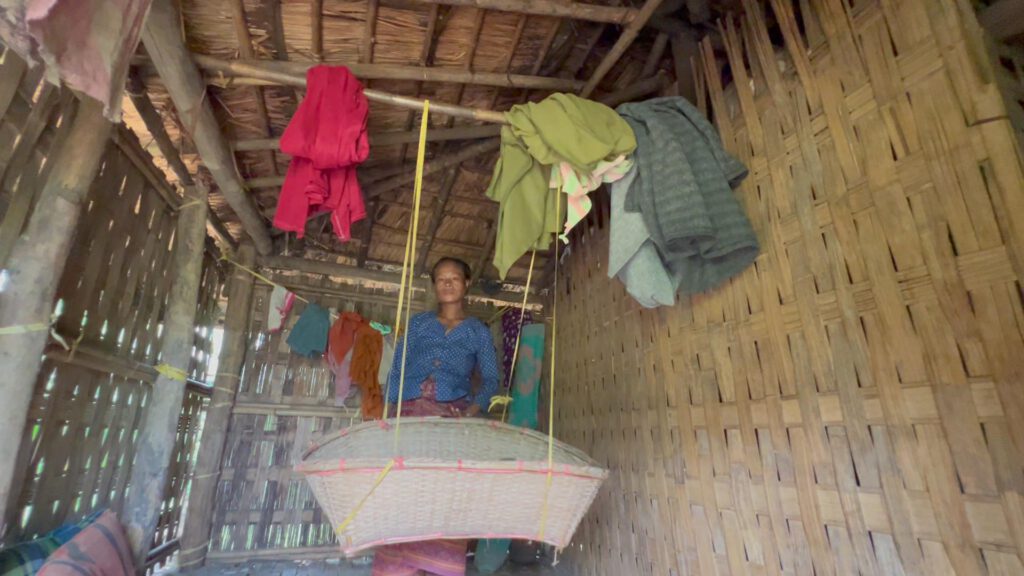
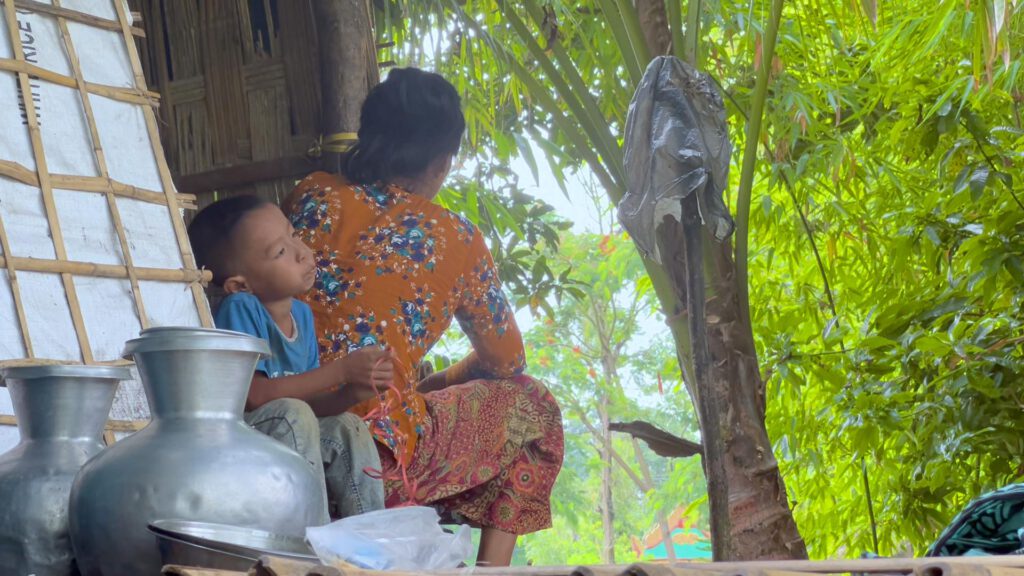
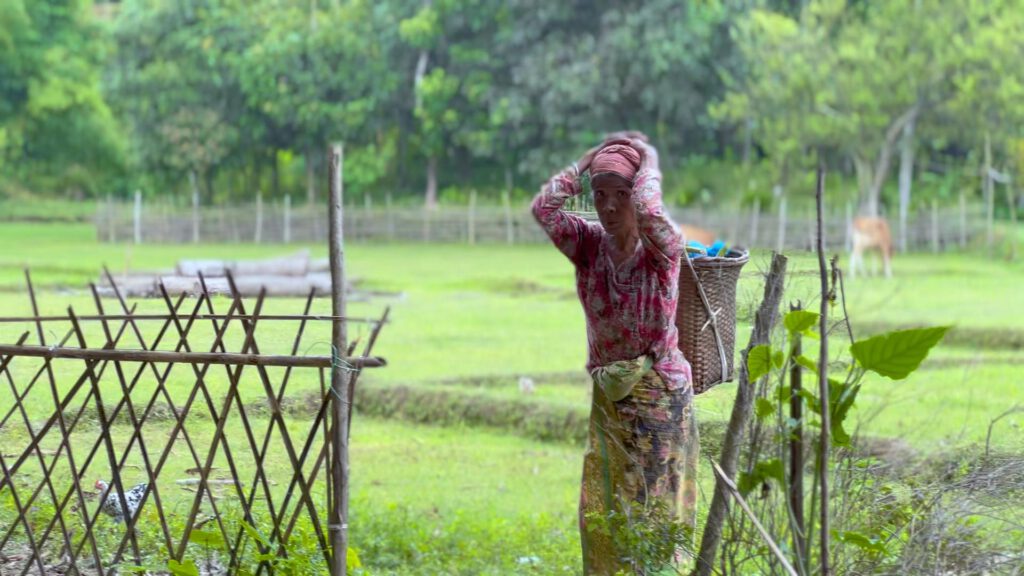
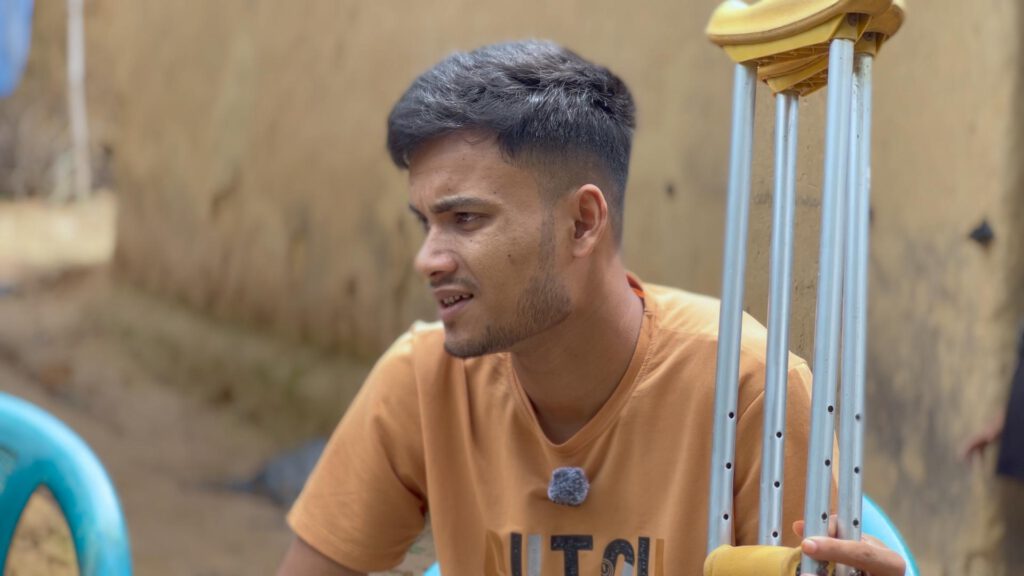
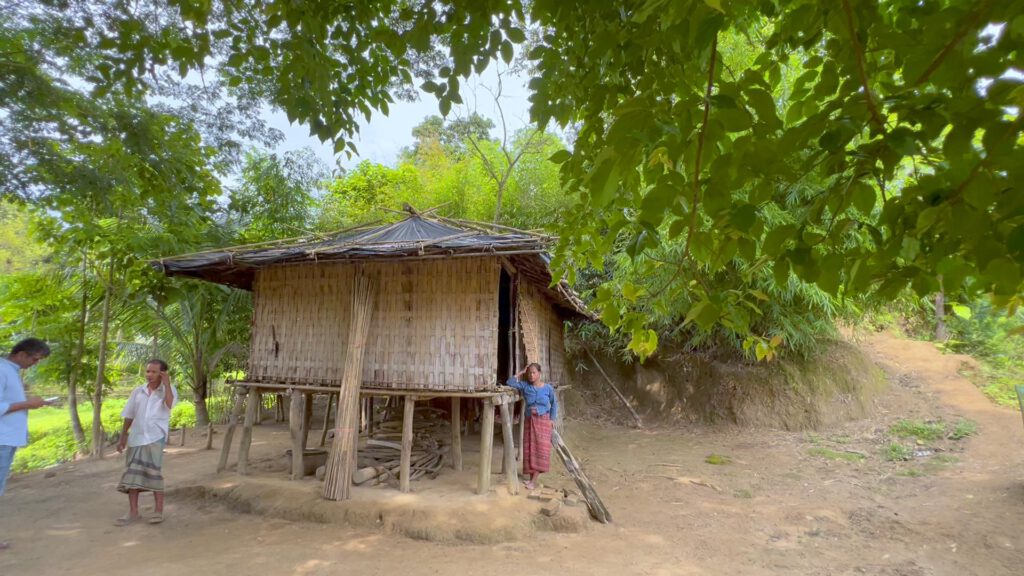
When the rain starts falling over the hills of Camp 20 in Ukhiya, Senoara Begum no longer sleeps.
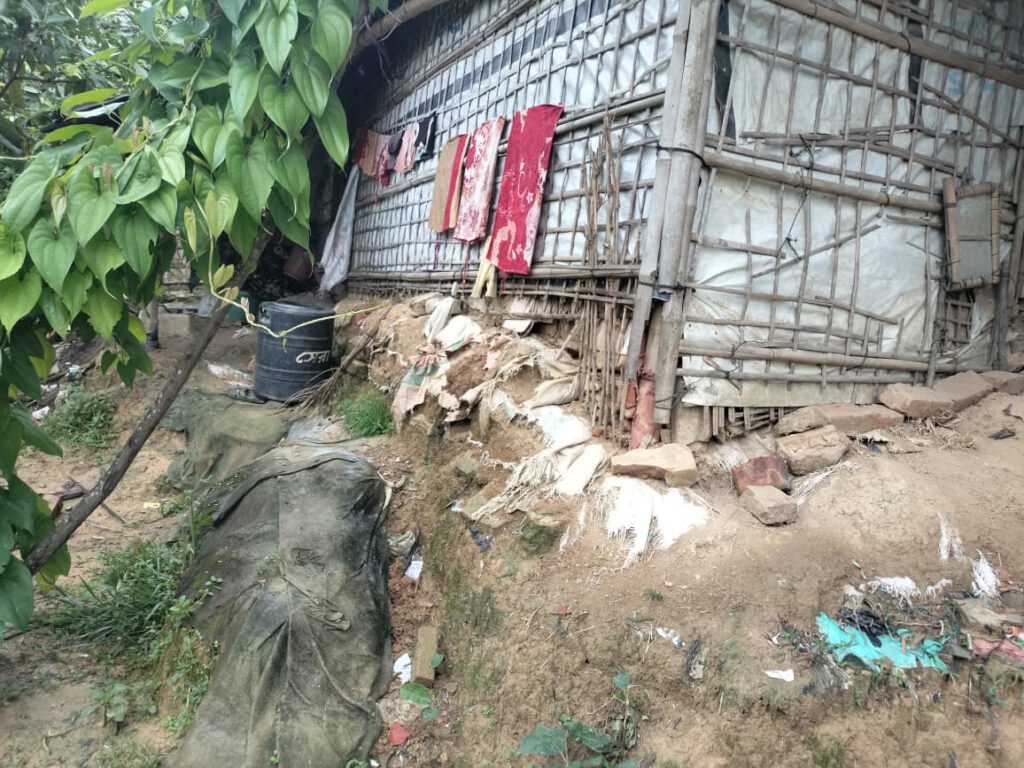
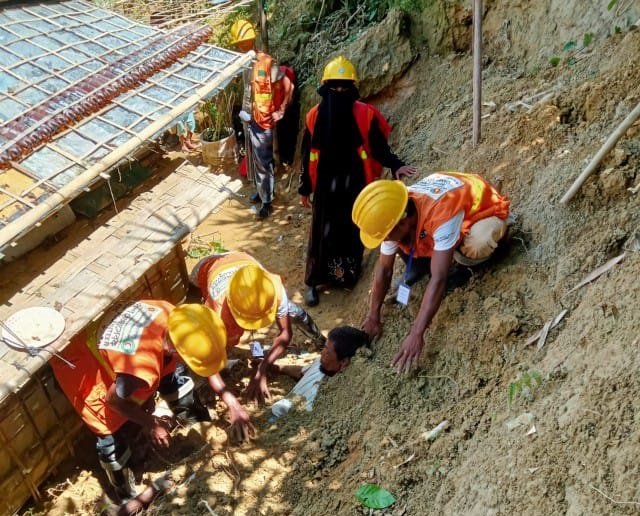
Her shelter — a fragile structure of bamboo poles and tarpaulin clinging to a steep hillside — sits beneath slopes that have claimed dozens of lives in the Rohingya refugee camps over the past five years.
“There is nowhere safe nearby to move,” she says quietly. “When aid agencies ask us to relocate, the places they offer are far from our neighbours and the community we’ve built. We don’t want to leave. But if the hillsides were properly maintained, the danger would be much less.”
For Senoara, the arrival of the monsoon is no longer simply a change in season. It is the return of uncertainty.
Across the vast refugee settlements of Ukhiya and Teknaf, thousands of Rohingya families live on, or directly beneath, steep hillsides stripped of their natural vegetation to make room for one of the world’s largest refugee settlements. Every spell of heavy rain weakens the soil. Every monsoon brings the fear that another hillside could collapse.
That fear is grounded in experience.
According to the UN Refugee Agency (UNHCR), landslides between 2021 and 2026 have killed 28 people and injured at least 80 across the camps. Twelve people died in 2024 alone, making it the deadliest year in the period. This year, although the rainy season has only just begun, two more people have already been killed and ten others injured.
“Landslides have claimed 28 lives and injured 80 people across the camps between 2021 and 2026,” says Shari Nijman, Communications Officer for UNHCR Bangladesh.
“Many vulnerable slopes remain without adequate stabilisation, increasing the exposure of refugee households and critical infrastructure to monsoon-related hazards.”
A Crisis Beyond the Rain
The danger is not caused by rainfall alone.
Humanitarian agencies say a deepening global funding crisis has forced them to scale back some of the very measures designed to prevent disasters.
Projects such as slope stabilisation, bamboo terracing, drainage maintenance and shelter reinforcement have been reduced as aid organisations prioritise life-saving food assistance and protection services amid shrinking donor support.
“The reduction in funding has significantly affected preventive engineering work,” humanitarian officials say, warning that vulnerable slopes are becoming increasingly difficult to maintain as resources diminish.
Relocation, often presented as the safest option, has proved equally challenging.
“Relocating families from the most dangerous hillside plots has long been one of the central challenges in camp management,” Nijman explains.
“These settlements are among the most densely populated places on earth. Vacant land is virtually non-existent. Many families are also reluctant to move because relocation often means losing access to livelihoods, markets and the social networks they have rebuilt since fleeing Myanmar in 2017.”
Living With Fear
In Camp 4, Salim Ullah says fear has become part of his family’s nightly routine whenever heavy rain begins.
“When it rains, I stay awake wondering when the hill will come down,” he says.
“I live on the slope with my children. We are always frightened.”
Across the camps, signs of self-protection are visible almost everywhere.
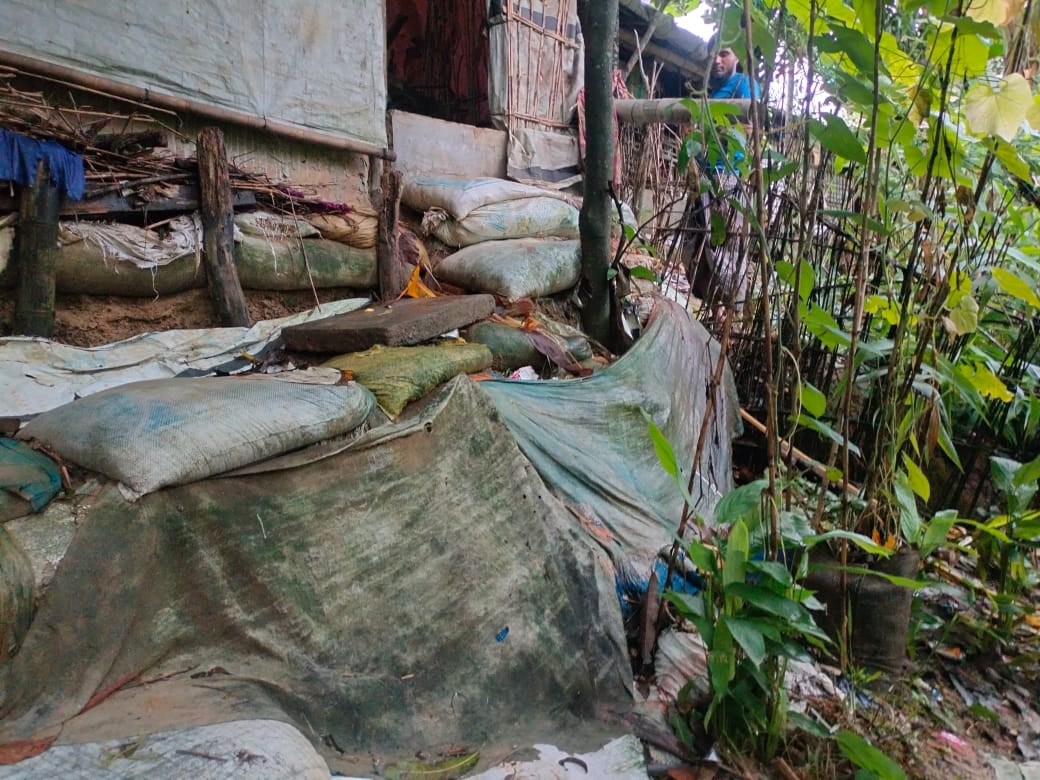
Families cover drainage channels with sheets of plastic to slow erosion. Sandbags are stacked against fragile shelters. Bamboo poles are driven into unstable embankments in makeshift attempts to hold the soil together.
But many acknowledge these are temporary solutions against a much larger threat.
Authorities on Alert
Bangladesh authorities say preparations are underway.
Refugee Relief and Repatriation Commissioner Md Mizanur Rahman says disaster management committees in every camp have been activated ahead of the monsoon. Awareness campaigns are continuing, while high-risk areas are being closely monitored.
“If conditions deteriorate, residents living in the most vulnerable locations will be evacuated,” he says.
Meanwhile, the Cox’s Bazar Meteorological Office reports that around 237 millimetres of rainfall has fallen over the past three weeks.
Assistant Meteorologist A.B. Hannan warns that rainfall is expected to intensify in the coming days, increasing the likelihood of further landslides.
Race Against Time
UNHCR says it continues to implement engineering and nature-based solutions wherever funding permits.
These include retaining walls, improved drainage systems, geotextile reinforcement and the planting of Vetiver grass, whose deep roots help bind loose soil together.
But the agency warns that without sustained international funding, such interventions cannot keep pace with growing risks.
As another monsoon settles over the camps, the question is no longer whether the hills will be tested — but whether enough has been done to prevent them from collapsing.
For Senoara Begum, the answer feels painfully uncertain.
Another rainy season has arrived.
And once again, she waits through the night, listening for the sound that every family living beneath the hills fears most.
Five fishermen aboard a Bangladeshi fishing trawler were allegedly detained by Myanmar’s armed group, the Arakan Army (AA), while fishing in the Bay of Bengal off the Teknaf coast on Sunday, according to local authorities and fishermen.
The detained fishermen were identified as trawler skipper Salam Nur, 31, Md Ayub, 37, Md Azizullah, 30, Sayed Hossain, 25, and another Md Ayub, 24.
Preliminary information indicates that all five are residents of the Rohingya refugee camps in Ukhiya and Teknaf.
Abul Kalam, General Secretary of the Kayukhali Ghat Fishing Boat Owners’ Association under Teknaf Municipality, said the fishermen were taken away while fishing near the coast, triggering fear among local fishing communities.
According to local fishermen, the trawler, owned by Ali Ahmad of Ali’r Dail village in Sabrang Union, left Kayukhali Ghat on Sunday morning for fishing. When it reached waters near Chera Dwip, members of the Arakan Army allegedly chased and intercepted the vessel before taking the trawler and its five crew members away.
Several nearby fishing trawlers managed to flee the area and return safely, they said.
Teknaf Upazila Nirbahi Officer S M Anik Chowdhury confirmed that the administration had received reports of the incident.
“Preliminary information indicates that all five are residents of Rohingya refugee camps. We are verifying the information and maintaining communication with the relevant authorities,” he said.
Arakan Army’s Version
Meanwhile, the Arakan Army issued a statement claiming that its Coast Guard Security Force detained the five Bangladeshi fishermen for allegedly entering Arakan’s territorial waters and engaging in illegal fishing.
According to the statement, Coast Guard personnel spotted a “suspicious motorized fishing boat” operating in the waters between Kyauk Pandu and Gyin Taw villages in Maungdaw Township on the afternoon of June 28. The statement alleged that the vessel attempted to flee after being signaled to stop for inspection.
The Arakan Army claimed that its Coast Guard pursued the trawler and seized it at around 1:40 pm, approximately 2.7 kilometres southwest of the mouth of Gyin Taw Creek, detaining the five Bangladeshi fishermen.
The Arakan Army maintained that the fishermen had been operating illegally inside Arakan territorial waters.
The Bangladeshi authorities have not independently verified the Arakan Army’s claim regarding the location of the incident, and efforts are underway to establish the exact circumstances surrounding the detention.
There is no war on the Bangladesh-Myanmar border. But people are dying. Someone cooking in their own kitchen. Someone playing in their courtyard. Someone working in a banana grove. Someone who went into the hills and never came back.
Every time, the same scene. Gunfire on the other side. Mortar shells fall. Armed groups clash. Sometimes a landmine explodes.
Then a family in some border village of Bangladesh is changed forever. News gets reported. Officials visit the scene. In some cases, a small amount of financial assistance arrives.
Then everything stops. Investigations stop. Justice stops. The visible presence of the state stops. But the grief of the border people does not.
Death Certificate Says ‘Natural Disaster’ After Mortar Shell Kills Woman in Her Kitchen 5 February 2024. In a home on the border edge of Ghumdhum Union in Naikhongchhari, Hosne Ara Begum was cooking.
At the time, fierce fighting was raging inside Myanmar. Suddenly, a mortar shell came flying from across the border.
Hosne Ara was killed on the spot. A Rohingya labourer died in the same incident. The autopsy report and hospital documents clearly stated that she died from blast injuries. But the family alleges that the death certificate later issued by the Union Parishad listed the cause of death as “natural disaster.”
Her son, Md. Ibrahim, says: “The MSF hospital papers clearly say death by bomb blast. But the Union Parishad death certificate says natural disaster. My question is — if a bomb comes from Myanmar and kills someone, how is that a natural disaster?”
In his words, that single phrase captures the entire political and administrative reality.
“Even a small child wants justice for their mother’s murder. Losing a mother means an entire family is destroyed. But we have come to understand — in this country, if you are killed at the border, there are very few places to seek justice.”
Hosne Ara’s husband, Badsha Mia, filed a case. But more than two years have passed with no visible progress.
“Police were saying they couldn’t catch the accused. If you want to keep the case going, go ahead — if not, leave it. After that, nothing happened.”
After 27 Days of Fighting, Hujaifa Loses the Battle Hujaifa was just 12 years old. She was playing in the courtyard with friends. A bullet came flying from the direction of the border. She was critically wounded and taken first to Chittagong, then to Dhaka.
After fighting for his life in the ICU for 27 days, the child died.
Her father, Jasim Uddin, still carefully keeps his daughter’s toys, socks, and the half-eaten packet of dal-bhaja from the day it happened. He kept stopping mid-sentence as he spoke. “She wasn’t fighting a war. She was sitting at a shop eating snacks, playing with toys. A bullet hit a child’s body. Then she fought death for 27 days.”
He says that at the time, the Arakan Army and the Rohingya armed group RSO were exchanging fire. At one point, armed members crossed into Bangladeshi territory and continued shooting. One of those bullets struck Hujaifa as she played in the courtyard. The family has filed no case. Because they do not know against whom to file one. “The bullet came from across the border. But whose door do I knock on for justice?”
Father Killed in Mine Blast Two Weeks Before His Child Was Born
24 May. In a hilly banana grove between border pillars 41 and 42 in the Tumru border area, a group of labourers had gone to work.
Suddenly, an explosion. Shaifuching Tanchangya, Akyamong Tanchangya, and Chikyang Tanchangya were killed on the spot.
All three were from Fatrajhiri area of Valukyapara in Ghumdhum Union, and all were the primary breadwinners of their families.
Shaifuching’s wife, Makingching, gave birth just seven days after the incident — she had lost her husband nearly two weeks before she would hold her child.
“He was supposed to come back with money from selling bananas. He never came back.” As government assistance, she received only a few thousand taka.
Nothing after that. No case. No news of any investigation. No compensation. Local Union Parishad member Angsai Marma says: “It was a devastating incident. While trying to save one person, two more died. Three families were destroyed overnight.”
‘What Is the Point of Talking?’
Dukmala Tanchangya lost her husband Akyamong Tanchangya in the same blast. But she does not want to speak to journalists.
Neighbours say her resentment toward the state runs so deep that she believes talking serves no purpose.
From a distance, Dukmala shouts: “We didn’t get justice. Instead, now they’re blaming us.” This silence reflects the long experience of the border people.
They have seen people die, get injured, and go missing — but not a single incident has ever reached a judicial conclusion.
The Missing Man — And No Search
Wamong Chakma has been missing for nearly four months. His wife, Usasing Chakma, says he went into the hilly border area to collect bamboo and never returned.
The family does not even know if he is alive. Most strikingly, they have not filed any case. Because they believe it would yield nothing.
Usasing says: “We contacted the police and BGB, but they said they could not go into that area. There is no news of whether Wamong is even alive.”
Naikhongchhari Police Station OC Mozammel Haque says GD entries have been made for at least two missing person cases in the border area — including Sumon Tanchangya and Waimong Chakma.
“No trace has been found yet. The matters are under investigation,” he says. He acknowledges, however, that police capacity for investigation in the remote border areas is limited.
“Legally, BGB has the primary responsibility in border areas. For any incident, we have to coordinate with them.”
Hanif Lost His Leg in His Own Country Md. Hanif, a resident of Lambabil area in Whaikyang, Teknaf, lost a leg to a mine explosion while walking to his own fish enclosure.
The incident happened inside Bangladesh — he was walking along the Naf riverbank toward his enclosure.
Suddenly, an explosion. In an instant, one leg was severed from his body. While hospitalised at Chittagong Medical College Hospital, he received 30,000 taka in assistance from the BGB.
Nothing came after. He now lives with his wife and child, dependent on his younger brother’s income.
Hanif says the explosion occurred roughly 20 feet inside the embankment, where enclosures are located before the Naf river. He believes mines may be scattered even further inland. He is now unemployed, staying home. His household runs entirely on his younger brother’s earnings.
“Who do I file a case against? Even the police didn’t come.”
What Is Happening Inside the Border?
Locals allege that armed groups of various kinds operate across wide stretches of the border.
Some name Rohingya armed factions. Others mention the Arakan Army. Still others say ordinary people have no way of knowing who belongs to which side.
As a result, going to work in the hills, grazing livestock, or visiting plantations has become dangerous.
Ulasing Tanchangya, a resident of Fatrajhiri area in Valukyapara, Ghumdhum Union, says: “If we don’t go to the hills, we can’t eat. But now going means risking death.”
He explains that people in this area grow bananas, papayas, ginger, mangoes, jackfruit, and betel leaves on the hills to earn a living. Unable to access their land, they are now facing extreme financial hardship and food insecurity.
What Does the BGB Say?
34 BGB Commanding Officer Lieutenant Colonel S.M. Khairul Alam says an investigation is underway into the source of the mines found near the border.
Preliminary assessment suggests that during clashes between Myanmar’s junta forces and the Arakan Army, some mines may have been planted or left behind in areas near the Bangladesh border.
“The matter is still under investigation. We don’t want to say anything definitively.”
He adds that BGB is conducting awareness campaigns in border areas — going house to house, warning residents not to touch any suspicious object and to immediately inform BGB. He also notes that in many hilly border areas, the zero line is not clearly demarcated, so locals often cannot tell whether they are inside Bangladesh or have crossed to the other side.
Why This Cycle of Impunity?
South Asian geopolitics analyst Altaf Parvez believes the root cause is the lack of effective control over the border.
“There is a state of war at the border. There is the Arakan Army, there are Rohingya armed groups, there is the Myanmar military. But ordinary people are bearing the greatest cost.” He argues that keeping the border safe is the state’s responsibility.
“But in reality, border people are living in a kind of uncertainty. Everyone knows what is happening, but there is very little social or political discussion about it.”
In his view, these people are effectively among Bangladesh’s most marginalised citizens. “City people live safely. Border people have to live with the risk.”
He adds: “These people are not at the centre of any discussion. They are not part of power politics. So their deaths do not become electoral issues.”
What Should the State Do?
Former Myanmar consulate head and security analyst Major (Retd.) Mohammad Emdadul Islam says the current situation is extremely complex — because in most cases the accused is not a state, but non-state armed groups.
“Bangladesh cannot take direct judicial action against groups like the Arakan Army. But it is urgent to strengthen mine detection, mine clearance, and preventive security measures along the border.”
He believes Bangladesh should build stronger preventive measures at the border and increase diplomatic pressure on Myanmar.
Are Border People Second-Class Citizens?
Hosne Ara. Hujaifa. Shaifuching. Akyamong. Chikyang. Wamong. Hanif. These are just a few names.
But within these names lies the long history of insecurity, fear, and impunity endured by the border people.
They did not fight. They are not members of any armed group.
They were simply at home, working their land, catching fish, raising their children. But they are the ones paying the price of war.
Coxs Bazar District Bar Association President Abdul Mannan asked the question: if a Bangladeshi citizen is killed by a mortar shell, shot dead by a bullet, disabled by a mine explosion, or goes missing inside Bangladesh — who bears responsibility for that?
“And if responsibility is never determined, where will justice come from? In one word — the state itself must take responsibility for the safety of its citizens.”
People are dying at the border. But as they die, the possibility of justice seems to die with them — and that, perhaps, is the greatest tragedy in all these stories.
Abdul Mannan asked: “Are the people of the border second-class citizens?”
Mathingching Tanchangya gave birth to a baby girl last week. But nearly three weeks before the child saw the light of day, her father lost his life.
Mathing’s husband, Shaifuching Tanchangya (32), was killed in a landmine explosion on May 24 while working on jhum cultivation land near the Bangladesh-Myanmar border. Two others — Okyamong Tanchangya (40), and Chikyong Tanchangya (34) — were also killed in the same incident. All three had gone to tend a banana plantation on the hillside.
To visit the victims’ families, this correspondent traveled last Saturday to Fatrajhiri in Ghumdhum Union of Naikhongchhari Upazila in Bandarban. The remote settlement lacks even mobile phone network coverage. After venturing further into Balukhia Para, Mathing’s home was finally located.
She was found standing in front of a traditional hill hut built on bamboo stilts. Inside, her newborn daughter was asleep in a cradle. When asked about the incident, Mathing began speaking but soon broke down in tears.
“How will I survive with these three children now? What will I do?” she said while crying uncontrollably. She repeatedly questioned why her husband had to lose his life while working on his own jhum land inside Bangladesh.
Unable to continue speaking due to her grief, her neighbour Ulaching stepped in. He said the jhum fields are about a two-hour walk from their village, with the Myanmar border another hour away. Shaifuching and the other two victims had gone there to work on their banana plantation.
According to Ulaching, Shaifuching was critically injured in an initial explosion while working in the plantation. When the others rushed to rescue him, a second blast injured them as well. All three later died at the scene. Villagers recovered the bodies with extreme caution.
A short distance from Mathing’s house stands the home of Okyamong. His eyes wife, Dukh Mala, was busy with household work and declined to speak after learning a journalist had arrived. She said previous media reports had stated that her husband and the others were killed after entering Myanmar, a claim she disputes. She is deeply worried about how she will support her three children.
Ulaching said nearly 400 Tanchangya families in the area have jhum land in regions where landmine explosions have occurred. Since the incidents, fear has prevented many from returning to their fields.
“Almost everyone has loans from NGOs. I have to pay around Tk 6,500 in installments every month. But I am too afraid to go to my banana plantation. The bananas are ripening and rotting in the fields. Our livelihoods are being destroyed,” he said.
He questioned who was planting landmines inside Bangladesh?
Days after the deaths of Shaifuching, Okyamong and Chikyong, another explosion occurred on June 9 in a banana plantation near Rezu Amtoli, also in Ghumdhum Union. Abdul Khalek, a 30-year-old Rohingya labourer, was killed while working there.
Local residents said the explosions occurred well inside Bangladeshi territory, far from the border line, making it difficult to believe that the mines had been planted by the Arakan Army from across the border. Since December 2024, Arakan Army has established control along the other side of the whole 271 kilometres Bangladesh border.
Several residents, speaking on condition of anonymity, claimed they had seen the presence of an armed Rohingya group in the area. They alleged that the group does not want locals entering the area and may have planted the mines for that reason. Residents also claimed that people encountered in the area are sometimes chased away.
If they can catch us, they will kill us in that area, they said.
According to local accounts, two hill residents of the same community disappeared in separate incidents last September and October while tending cattle in the area. They were Waimong Tanchangya of Balukhia Para and Suman Tanchangya of neighboring Rezu Gorjonbunia area.
The wife of Waimong, 55-year-old Usaching, was encountered while transporting jackfruit collected from the hills for sale. She said her husband disappeared seven to eight months ago while grazing cattle and never returned. Villagers later found signs suggesting he had been dragged away. Suman also remains missing since then, locals said.
Former Ghumdhum Union Parishad member Babul Kanti Chakma said Waimong disappeared during the third week of September last year, while Suman went missing on October 8. Fear has gripped local residents for the past seven to eight months, discouraging many from visiting their jhum fields.
He confirmed that the families filed general diaries with Naikhongchhari Police Station regarding the disappearances.
Mozammel Haque, Investigation Officer at Naikhongchhari Police Station, said both disappearance cases remain under investigation. The deep jungle terrain has slowed progress, he added.
He said police recovered the bodies after being informed of the landmine blast that killed the three men and completed the necessary legal procedures. He added that the Border Guard Bangladesh (BGB) has been conducting public awareness campaigns in the area and that police have requested BGB to carry out mine swiping operations using modern equipment.
Regarding the recent landmine explosions inside Bangladesh, Lieutenant Colonel SM Khairul Alam, commanding officer of BGB Battalion 34, said preliminary assessments suggest that during clashes and pursuits between Myanmar’s military junta and the Arakan Army, members of both sides occasionally crossed into Bangladeshi territory and may have planted or left behind mines.
However, he emphasized that this is not a final conclusion and that investigations are ongoing.
He said BGB has already been distributing leaflets and conducting awareness campaigns door-to-door, urging residents to immediately report any suspicious objects or activities.
Explaining the border terrain, Lt Col Khairul said the zero line is often difficult to identify in hilly areas where jhum cultivation takes place. He noted that one recent explosion occurred about 20 yards inside Myanmar territory.
“In the hills, it is often difficult to determine whether someone is standing in Bangladesh or Myanmar,” he said, adding that residents are being advised to avoid areas close to the zero line to prevent confusion and danger.
According to BGB, local authorities and border residents, at least 10 people have been killed and more than 40 injured in landmine and unexploded ordnance blasts along the Naikhongchhari border between late 2024 and June this year.
The victims include Bangladeshi farmers, hill workers, Rohingya refugees, woodcutters and even BGB personnel. While deaths from mine explosions previously occurred across the border, recent incidents inside Bangladeshi territory have heightened fear among border communities.
Seven Bangladeshi fishermen, along with two engine-powered fishing boats, were detained by Myanmar’s armed group, the Arakan Army, while fishing in the Bay of Bengal and the Naf River estuary off Teknaf in Cox’s Bazar.
The incident occurred around 9:00 am on Monday in waters adjacent to Shah Porir Dwip. Teknaf Upazila Nirbahi Officer (UNO) S.M. Anik Chowdhury confirmed the incident at around 5:00 pm.
He said the administration learned of the matter through the Coast Guard and has contacted the families of the detained fishermen. Initial information confirmed that seven fishermen had been taken away.
“The fishermen mistakenly entered Myanmar waters and were detained. The BGB, Coast Guard and local administration are working in coordination to bring them back to Bangladesh as quickly as possible,” he said.
Abdul Mannan, a member of Ward No. 7 of Shah Porir Dwip Union, said the fishermen were detained near Myanmar’s Naikhyongdia area, at the estuary of the Naf River and the Bay of Bengal, about six kilometres southeast of the border area under the jurisdiction of the Shah Porir Dwip BOP of Border Guard Bangladesh (BGB)-2.
Local fishermen said the group had gone fishing from the South-East Para ghat of Shah Porir Dwip using two engine-powered fishing boats. While returning after fishing, they unintentionally crossed into Myanmar waters, where members of the Arakan Army detained them.
The detained fishermen were identified as Faisal, 26, Jalil, 16, Azam, 12, Helal, 11, Lalya, 19, Syed Alam, 21, and another Faisal, 22. All are residents of Shah Porir Dwip in Teknaf.
The two fishing boats belong to Md Razzak, 40, of Konapara in Shah Porir Dwip, according to local sources.
Local residents alleged that Bangladeshi fishermen fishing in the border areas of the Naf River and in the Bay of Bengal frequently face harassment and detention by various armed groups. They urged the authorities to ensure the safe and swift return of the detained fishermen.
A case has been filed in connection with the alleged gang rape of a 40-year-old mother and her 15-year-old daughter at their home in Cox’s Bazar’s newly-formed Matamuhuri upazila, as police continue their hunt for the prime suspect and remaining accused.
The incident occurred at around 2:30am on Tuesday in the Dolnighona area, when a gang of eight to ten armed men broke into the family home by cutting through a window grille. The victims’ husband and father was away in Chattogram on business at the time. A five-year-old child, the younger daughter of the family, was also present in the house during the attack.
Quoting family members, Abhijit Das, Assistant Superintendent of Police for the Chakaria Circle, said the gang looted gold jewellery and cash before sexually assaulting both the mother and her teenage daughter, and then fled the scene.
Chakaria Police Station Officer-in-Charge (OC) Md. Monir Hossain confirmed that the victim herself — the mother — filed the case after midnight on Wednesday, following treatment at Cox’s Bazar Sadar Hospital. The case names seven identified suspects and includes five to six unidentified people as accused.
Of the six men detained on Tuesday, five are named in the case as accused. The sixth, Rezaul Karim (36), was produced before the court as a suspect, as his name does not appear in the case. All six have been produced before the Chakaria Senior Judicial Magistrate Court.
The six detained individuals are: Rezaul Karim (36), brothers Tofazzal Hossain alias Babu (23) and Kefayat Hossain alias Puittya (27), Mohammad Tanzid (24) — all from the Dolnighona area of Matamuhuri upazila — Mehedi Hasan (24) of Kaddachara in Saharabil union, and Mohammad Tareq (26) of Koralkhali area.
The family has repeatedly named a locally feared criminal identified only as Jisan as a key figure behind the attack. However, he remains at large since the incident. OC Monir Hossain confirmed that Jisan has also been named in the case.
ASP Abhijit Das had earlier disclosed that Jisan was released from jail just five days before the attack, where he had been serving time on weapons and robbery charges. He described several of those involved in the attack as hardened criminals.
OC Monir Hossain said operations are ongoing to arrest the remaining suspects, and efforts are underway to identify the unidentified accused. Family members have alleged that the same criminal group had targeted their household on two to three previous occasions.
A horrifying incident of armed robbery followed by gang rape has taken place in the newly formed Matamuhuri Upazila, where a mother and her teenage daughter were sexually assaulted after criminals looted gold ornaments and cash from their home. Police have confirmed that both victims are currently receiving treatment at Cox’s Bazar Sadar Hospital.
The incident occurred around 2:30am on Tuesday (June 9) in the Dolnighona area of Sikdarpara, under East Borobheola Union of the upazila.
Police have so far arrested six individuals in connection with the case. The arrestees are: Rezaul Karim (36), Tofazzal Hossain alias Babu (23) and his brother Kefayat Hossain alias Puittya (27), Mohammad Tanzid (24) — all from the Dolunighona area of Matamuhuri Upazila — Mehedi Hasan (24) from the Kaddachara area of Saharbil Union, and Mohammad Tareq (26) from the Koralkhali area.
Quoting members of the victims’ family, Assistant Superintendent of Police (Chakaria Circle) Abhijit Das said that a gang of eight to 10 armed criminals cut through the window grille of the house and forced their way inside. They looted cash, gold jewellery and other valuables before gang-raping the expatriate worker’s wife, aged 40, and her daughter, aged 15, and then fleeing the scene. A five-year-old child of the woman was also present in the house during the attack. The husband of the woman lives in Chattogram for business purposes.
The critically injured mother and daughter were first taken to Chakaria Upazila Health Complex. As their condition deteriorated, they were transferred to Cox’s Bazar Sadar Hospital for advanced medical care.
After inspecting the scene, the ASP confirmed that an organised local criminal network was responsible for the attack. Family sources claim the same group had targeted this family on multiple previous occasions.
One of those involved in the attack had been arrested by police just days earlier carrying weapons and was already a defendant in robbery and arms cases. That individual, identified as Jisan, had been released from jail only five days before the attack. Several members of the gang are described by police as hardened repeat offenders.
Following the incident, local residents and law enforcement jointly cordoned off the entire area. The six arrests were made during an operation conducted from dawn through the morning on Tuesday.
The uncle of the teenage victim told journalists that his sister and his tenth-grade niece had been subjected to brutal assault by the local criminal gang. The niece’s condition remains critical — doctors are keeping her under intensive care due to severe blood loss.
He further said that this criminal group had attacked their family two to three times previously, and that several members — including Jisan and his brother — are among the most dangerous and notorious offenders in the area.
Contacted, Cox’s Bazar Sadar Hospital’s Residential Medical Officer (RMO) Dr. Subaktabin Sohel said the mother and daughter were admitted to One Stop Crisis Centre (OCC) of the hospital.
After completing necessary diagnosis and treatment, they were discharged from the hospital in the afternoon. The physical condition of the girl was stable, he said.
The United Nations and its partner agencies have appealed for $710.5 million in fresh international assistance to meet the urgent needs of Rohingya refugees and host communities in coordination with the Bangladesh government.
The UN also warned that hopes for the Rohingyas’ early return to Myanmar are fading as conflict continues inside Rakhine State.
The appeal was made on Wednesday during the presentation of the updated 2026 Joint Response Plan (JRP) at the UN building in Dhaka. The plan aims to provide assistance to around 1.56 million Rohingya refugees and host community members living in Cox’s Bazar and Bhasan Char.
According to the UN, growing global instability, conflicts and humanitarian crises are reducing international aid, putting essential services in the Rohingya camps — including food, healthcare, education and protection — at risk.
Bangladesh is currently hosting around 1.2 million Rohingya refugees. Since the beginning of 2024, nearly 150,000 more Rohingyas have entered Bangladesh due to ongoing conflict in Myanmar’s Rakhine State, further increasing pressure on the overcrowded camps.
Under the JRP, the proposed funding includes $247.3 million for food assistance, $128 million for shelter, $61.2 million for water, sanitation and hygiene, $52.7 million for education, $49.9 million for healthcare, and $35.1 million for livelihoods and skills development. Another $36.2 million has been allocated to support affected host communities.
The UN said the international community has provided around $5.42 billion in assistance for the Rohingya crisis from 2017 through the end of 2025, with the United States remaining the largest donor.
Among those speaking at the event were Kelly T. Clements, Deputy High Commissioner of the United Nations High Commissioner for Refugees, Rania Dagash-Kamara, Assistant Executive Director of the World Food Programme, and Nyaradzayi Gumbonzvanda, Deputy Executive Director of UN Women.
Kelly T. Clements said, “At a time when resources are becoming increasingly limited, strengthening refugees’ skills and resilience is more important than ever so they can become self-reliant and maintain hope for the future.”
Rania Dagash-Kamara said Bangladesh had shown “extraordinary generosity” by sheltering the Rohingyas, adding that continued donor support remained a lifeline for the refugees.
Nyaradzayi Gumbonzvanda said the impact of funding shortages had already started affecting daily life in the camps, with women and girls facing heightened risks and violence due to displacement.
According to the UN, around 35 percent of families in the camps are entirely dependent on food assistance, while 42 percent rely on temporary and uncertain income sources. Only 23 percent of households are currently involved in cash-based humanitarian work opportunities.
The UN further warned that ongoing conflict in Rakhine State is dimming prospects for repatriation in the near future, prompting many Rohingyas to attempt dangerous sea journeys to other countries. According to the agency, such journeys became the deadliest in 2025. Last month, a boat carrying more than 270 passengers capsized, with only nine survivors rescued.
Bangladesh Foreign Ministry Secretary (Intergovernmental Organizations) and Acting Foreign Secretary M. Farhadul Islam and interim UN Resident Coordinator Carol Flore were also present at the JRP launch event. A total of 98 humanitarian partners, including 52 Bangladeshi organisations, have endorsed the plan.
The United Nations reiterated that the only sustainable solution to the Rohingya crisis is safe, voluntary and dignified repatriation, adding that continued international support remains essential until conditions in Myanmar become conducive for return.
A court in Cox’s Bazar has sentenced four accused to death and nine others to life imprisonment in the widely discussed murder case of Bangladesh Army officer Lieutenant Tanzim Sarwar Nirjon.
Five accused were acquitted in the case.
The verdict was delivered on Wednesday afternoon by Judge Mohammad Abul Mansur Siddiqui of the Additional District and Sessions Judge (Fifth) Court in Cox’s Bazar.
Those sentenced to death are Md Helal Uddin, Nurul Amin, Md Nasir Uddin and Morshed Alam. Among them, Morshed Alam remains absconding. All are residents of Dulahazara union in Chakaria upazila.
The verdict drew significant attention at the courthouse, ending nearly one year and eight months of legal proceedings in one of the country’s most talked-about criminal cases.
Following the judgment, chief prosecutor Mohammad Jahangir said the young army officer had fallen victim to a brutal killing while carrying out his duty in service of the country.
“His family, the Bangladesh Army, the state and the people all expected justice to be ensured,” he said.
He added that the court had not relied solely on allegations or one-sided testimonies. Instead, it examined witness statements, evidence, surrounding circumstances and the overall facts of the case before delivering what he described as an exemplary punishment for four of the accused.
Another prosecution lawyer, Ahsan Sezan, said the atmosphere in the dock remained calm after the verdict, although the expressions and behaviour of the accused reflected “a visible sense of guilt”.
“Lieutenant Tanzim was a patriotic officer. He went there to protect people’s lives and property and to ensure public security. But he was brutally killed in the situation that unfolded,” he said.
He said verdicts in both the murder and Arms Act cases were delivered on Wednesday. Alongside the death sentences and life terms, 13 accused were also handed an additional 10 years in prison under sections 399 and 402 of the Penal Code.
Sezan said the prosecution was “reasonably satisfied” with the judgment. He noted that the judge had highlighted issues of social justice, public safety and discipline in his observations.
“The court also stressed that while ensuring punishment for the real offenders, it must equally ensure that no innocent person is convicted,” he added.
He further said the verdict was delivered after considering both the prosecution’s evidence and the defence’s cross-examinations. The full judgment regarding the five acquitted accused would be reviewed and further legal steps could be taken if necessary.
Meanwhile, several defence lawyers said they had been denied justice and would challenge the verdict before the High Court.
Tahsin Sifat, lawyer for the fifth and sixth accused, said they were dissatisfied with the ruling, particularly the life sentences and separate punishments under the Arms Act imposed on his clients.
“We believe they have been deprived of justice. Therefore, we will appeal against the verdict before the higher court,” he said.
Lieutenant Tanzim Sarwar Nirjon, 23, was killed around 1:30am on Sept 23, 2024 while conducting an anti-robbery operation in the East Maizpara area of Dulahazara union in Chakaria.
Originally from Tangail, Tanzim had been commissioned from the Bangladesh Military Academy in 2022 and was serving in the Army Service Corps. His killing triggered nationwide outrage and mourning.
Two days after the incident, Senior Warrant Officer Abdullah Al Harunur Rashid filed a murder case against 17 people over the killing and alleged robbery preparations. In a separate case, Chakaria Police Station Sub-Inspector Alamgir Hossain filed charges under the Arms Act.
Later, Chakaria Police Station Inspector (Investigation) Arup Kumar Chowdhury was assigned to investigate the cases.
After completing the investigation, police submitted charge sheets against 18 people in the two cases. Several individuals named in the original complaint were dropped due to lack of evidence, while new accused were added based on the findings of the investigation.
A controversy has emerged over the construction of a new type of two-storey housing in the Kutupalong refugee camp in Ukhiya, Cox’s Bazar.
Locals said the use of concrete bases, steel structures, and hill-cutting for road construction suggests the infrastructure is “not temporary, but an indication of permanent settlement.” The Forest Department has also raised objections, saying hills have been cut during the construction process.
However, the Refugee Relief and Repatriation Commission (RRRC) and UNHCR said the structures are still temporary.
At least 888 two-storey shelters are being built in Extension ‘E’ Block of Camp-4 in Kutupalong, with around 80–90 percent of the work already completed. The Forest Department said hills have been flattened for construction and roads about 10 feet wide have been built.
Statements were sought from UNHCR, the RRRC, and the Forest Department regarding the issue.
Forest Department alleges hill cutting
Ukhiya Range Officer of Cox’s Bazar South Forest Division, Abdul Mannan, said, “Two-storey steel-structured shelters are being constructed for Rohingyas in Camp-4 after cutting hills. We have come to know about the matter and strongly protested it.
“This is reserved forest land. However, as the camp area is under the jurisdiction of the relevant authorities, we are unable to exercise direct control. Hundreds of workers are involved, so construction is progressing rapidly. Around 800–900 shelters are already 80–90 percent complete.”
He said the work is causing significant environmental damage, including hill cutting and deforestation. “We tried to resist from our position, but given the scale of the work, it was not effective.”
He added, “The area was previously reserved forest land. The extent of land leveling indicates hills have been cut. You should also take statements from the RRRC and camp authorities.”
Commissioner says “nothing permanent”
RRRC Commissioner Mohammad Mizanur Rahman said the structures are being misinterpreted.
He said the shelters are being built based on a design approved by an inter-ministerial committee around 2021–22.
“Although steel structures are being used, they are assembled with nuts and bolts so they can be dismantled easily. This is not a permanent structure,” he said.
Regarding the use of concrete, he said, “It is not a full concrete base; rather, a floor-like foundation is being provided so the structure does not sit directly on the ground.” He added that work has been temporarily halted following objections over hill cutting.
UNHCR says “improved design for safety”
UNHCR said the new shelters are designed to improve disaster resilience.
Mosharraf Hossain, communications officer of UNHCR Bangladesh, said bamboo and plastic sheets remain the primary materials, with steel pipes of up to three inches in diameter used, and the structures are connected with nuts and bolts so they can be dismantled easily.
“These shelters under construction are not permanent structures and do not indicate any change in the temporary nature of Rohingya stay in Bangladesh. The design has been approved by the relevant authorities. It reflects a collective humanitarian effort to ensure safer living conditions, while respecting Bangladesh’s long-standing position that safe, voluntary, and dignified repatriation remains the ultimate solution,” he said.
Local concerns
A clear gap is visible between ground realities and policy positions.
On one hand, locals see hill cutting, road construction, and two-storey structures as signs of a long-term presence. On the other, government and international agencies insist the shelters are improved but temporary solutions.
Palongkhali Union Parishad Chairman M Gofur Uddin Chowdhury said the construction is concerning.
“If strong infrastructure is built, it may pave the way for permanent settlement of Rohingyas, which could hinder the repatriation process,” he said.