
Aid Cuts Leave Thousands Exposed to Landslides in Rohingya Camps

By Staff Correspondent | Cox’s Bazar

When the rain starts falling over the hills of Camp 20 in Ukhiya, Senoara Begum no longer sleeps.

Her shelter — a fragile structure of bamboo poles and tarpaulin clinging to a steep hillside — sits beneath slopes that have claimed dozens of lives in the Rohingya refugee camps over the past five years.

“There is nowhere safe nearby to move,” she says quietly. “When aid agencies ask us to relocate, the places they offer are far from our neighbours and the community we’ve built. We don’t want to leave. But if the hillsides were properly maintained, the danger would be much less.”

For Senoara, the arrival of the monsoon is no longer simply a change in season. It is the return of uncertainty.

Across the vast refugee settlements of Ukhiya and Teknaf, thousands of Rohingya families live on, or directly beneath, steep hillsides stripped of their natural vegetation to make room for one of the world’s largest refugee settlements. Every spell of heavy rain weakens the soil. Every monsoon brings the fear that another hillside could collapse.

That fear is grounded in experience.

According to the UN Refugee Agency (UNHCR), landslides between 2021 and 2026 have killed 28 people and injured at least 80 across the camps. Twelve people died in 2024 alone, making it the deadliest year in the period. This year, although the rainy season has only just begun, two more people have already been killed and ten others injured.

“Landslides have claimed 28 lives and injured 80 people across the camps between 2021 and 2026,” says Shari Nijman, Communications Officer for UNHCR Bangladesh.

“Many vulnerable slopes remain without adequate stabilisation, increasing the exposure of refugee households and critical infrastructure to monsoon-related hazards.”

A Crisis Beyond the Rain

The danger is not caused by rainfall alone.

Humanitarian agencies say a deepening global funding crisis has forced them to scale back some of the very measures designed to prevent disasters.
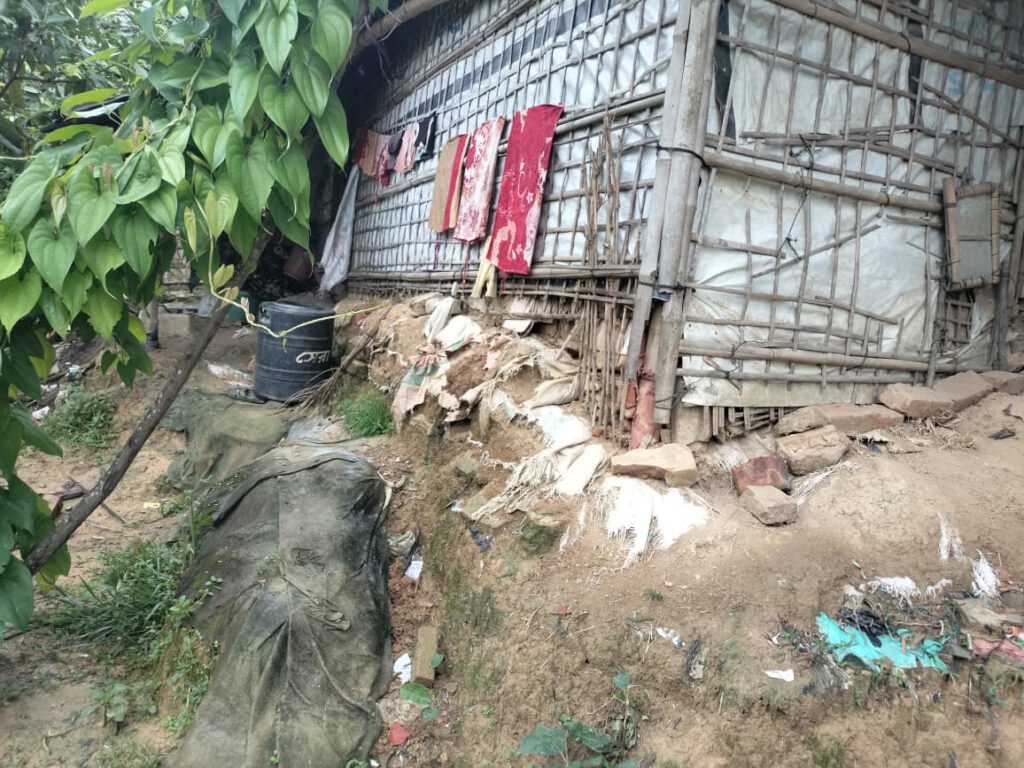
Projects such as slope stabilisation, bamboo terracing, drainage maintenance and shelter reinforcement have been reduced as aid organisations prioritise life-saving food assistance and protection services amid shrinking donor support.

“The reduction in funding has significantly affected preventive engineering work,” humanitarian officials say, warning that vulnerable slopes are becoming increasingly difficult to maintain as resources diminish.

Relocation, often presented as the safest option, has proved equally challenging.

“Relocating families from the most dangerous hillside plots has long been one of the central challenges in camp management,” Nijman explains.

“These settlements are among the most densely populated places on earth. Vacant land is virtually non-existent. Many families are also reluctant to move because relocation often means losing access to livelihoods, markets and the social networks they have rebuilt since fleeing Myanmar in 2017.”

Living With Fear

In Camp 4, Salim Ullah says fear has become part of his family’s nightly routine whenever heavy rain begins.

“When it rains, I stay awake wondering when the hill will come down,” he says.

“I live on the slope with my children. We are always frightened.”
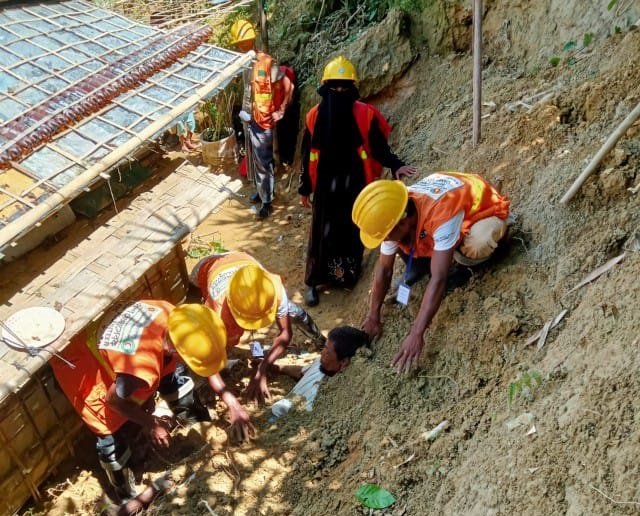
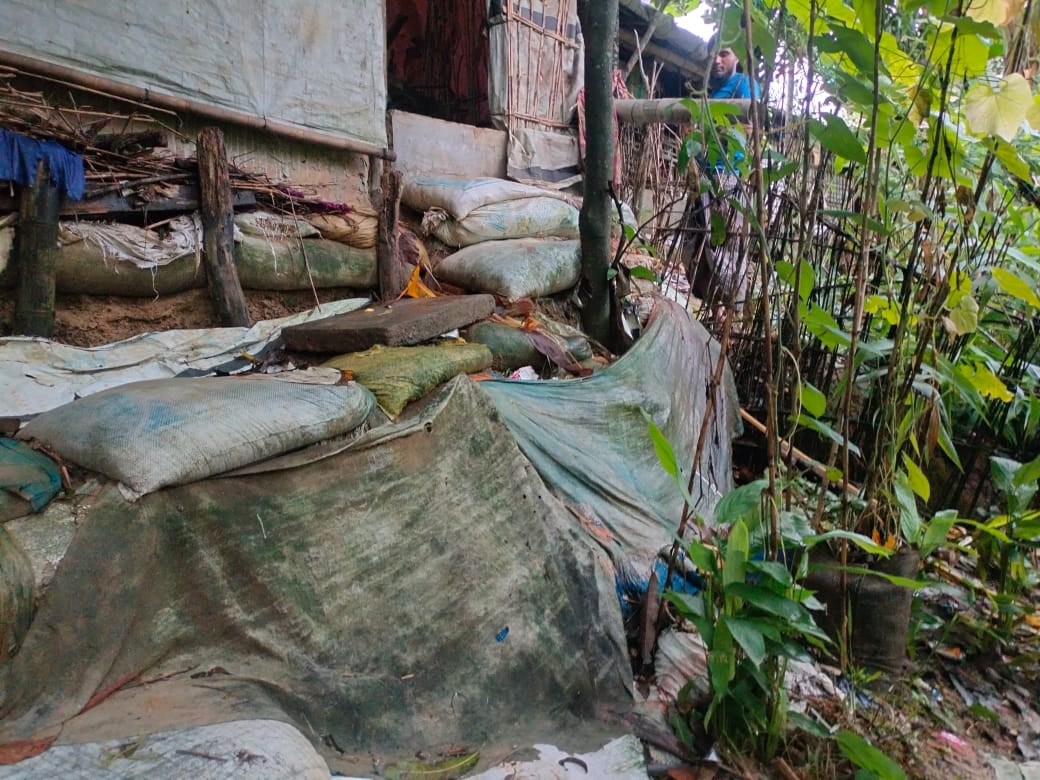
Across the camps, signs of self-protection are visible almost everywhere.

Families cover drainage channels with sheets of plastic to slow erosion. Sandbags are stacked against fragile shelters. Bamboo poles are driven into unstable embankments in makeshift attempts to hold the soil together.

But many acknowledge these are temporary solutions against a much larger threat.

Authorities on Alert

Bangladesh authorities say preparations are underway.

Refugee Relief and Repatriation Commissioner Md Mizanur Rahman says disaster management committees in every camp have been activated ahead of the monsoon. Awareness campaigns are continuing, while high-risk areas are being closely monitored.

“If conditions deteriorate, residents living in the most vulnerable locations will be evacuated,” he says.

Meanwhile, the Cox’s Bazar Meteorological Office reports that around 237 millimetres of rainfall has fallen over the past three weeks.

Assistant Meteorologist A.B. Hannan warns that rainfall is expected to intensify in the coming days, increasing the likelihood of further landslides.

Race Against Time

UNHCR says it continues to implement engineering and nature-based solutions wherever funding permits.
These include retaining walls, improved drainage systems, geotextile reinforcement and the planting of Vetiver grass, whose deep roots help bind loose soil together.

But the agency warns that without sustained international funding, such interventions cannot keep pace with growing risks.

As another monsoon settles over the camps, the question is no longer whether the hills will be tested — but whether enough has been done to prevent them from collapsing.

For Senoara Begum, the answer feels painfully uncertain.

Another rainy season has arrived.

And once again, she waits through the night, listening for the sound that every family living beneath the hills fears most.

$710 million aid appeal: As UN warns Rohingyas’ hope of return to Myanmar is fading

Bay Insight, Desk

The United Nations and its partner agencies have appealed for $710.5 million in fresh international assistance to meet the urgent needs of Rohingya refugees and host communities in coordination with the Bangladesh government.

The UN also warned that hopes for the Rohingyas’ early return to Myanmar are fading as conflict continues inside Rakhine State.

The appeal was made on Wednesday during the presentation of the updated 2026 Joint Response Plan (JRP) at the UN building in Dhaka. The plan aims to provide assistance to around 1.56 million Rohingya refugees and host community members living in Cox’s Bazar and Bhasan Char.

According to the UN, growing global instability, conflicts and humanitarian crises are reducing international aid, putting essential services in the Rohingya camps — including food, healthcare, education and protection — at risk.

Bangladesh is currently hosting around 1.2 million Rohingya refugees. Since the beginning of 2024, nearly 150,000 more Rohingyas have entered Bangladesh due to ongoing conflict in Myanmar’s Rakhine State, further increasing pressure on the overcrowded camps.

Under the JRP, the proposed funding includes $247.3 million for food assistance, $128 million for shelter, $61.2 million for water, sanitation and hygiene, $52.7 million for education, $49.9 million for healthcare, and $35.1 million for livelihoods and skills development. Another $36.2 million has been allocated to support affected host communities.

The UN said the international community has provided around $5.42 billion in assistance for the Rohingya crisis from 2017 through the end of 2025, with the United States remaining the largest donor.

Among those speaking at the event were Kelly T. Clements, Deputy High Commissioner of the United Nations High Commissioner for Refugees, Rania Dagash-Kamara, Assistant Executive Director of the World Food Programme, and Nyaradzayi Gumbonzvanda, Deputy Executive Director of UN Women.

Kelly T. Clements said, “At a time when resources are becoming increasingly limited, strengthening refugees’ skills and resilience is more important than ever so they can become self-reliant and maintain hope for the future.”

Rania Dagash-Kamara said Bangladesh had shown “extraordinary generosity” by sheltering the Rohingyas, adding that continued donor support remained a lifeline for the refugees.

Nyaradzayi Gumbonzvanda said the impact of funding shortages had already started affecting daily life in the camps, with women and girls facing heightened risks and violence due to displacement.

According to the UN, around 35 percent of families in the camps are entirely dependent on food assistance, while 42 percent rely on temporary and uncertain income sources. Only 23 percent of households are currently involved in cash-based humanitarian work opportunities.

The UN further warned that ongoing conflict in Rakhine State is dimming prospects for repatriation in the near future, prompting many Rohingyas to attempt dangerous sea journeys to other countries. According to the agency, such journeys became the deadliest in 2025. Last month, a boat carrying more than 270 passengers capsized, with only nine survivors rescued.

Bangladesh Foreign Ministry Secretary (Intergovernmental Organizations) and Acting Foreign Secretary M. Farhadul Islam and interim UN Resident Coordinator Carol Flore were also present at the JRP launch event. A total of 98 humanitarian partners, including 52 Bangladeshi organisations, have endorsed the plan.

The United Nations reiterated that the only sustainable solution to the Rohingya crisis is safe, voluntary and dignified repatriation, adding that continued international support remains essential until conditions in Myanmar become conducive for return.

Controversy over construction of concrete and steel housing in Rohingya camps

Bay insight | Cox’s Bazar

A controversy has emerged over the construction of a new type of two-storey housing in the Kutupalong refugee camp in Ukhiya, Cox’s Bazar.

Locals said the use of concrete bases, steel structures, and hill-cutting for road construction suggests the infrastructure is “not temporary, but an indication of permanent settlement.”
The Forest Department has also raised objections, saying hills have been cut during the construction process.

However, the Refugee Relief and Repatriation Commission (RRRC) and UNHCR said the structures are still temporary.

At least 888 two-storey shelters are being built in Extension ‘E’ Block of Camp-4 in Kutupalong, with around 80–90 percent of the work already completed. The Forest Department said hills have been flattened for construction and roads about 10 feet wide have been built.

Statements were sought from UNHCR, the RRRC, and the Forest Department regarding the issue.

Forest Department alleges hill cutting

Ukhiya Range Officer of Cox’s Bazar South Forest Division, Abdul Mannan, said, “Two-storey steel-structured shelters are being constructed for Rohingyas in Camp-4 after cutting hills. We have come to know about the matter and strongly protested it.

“This is reserved forest land. However, as the camp area is under the jurisdiction of the relevant authorities, we are unable to exercise direct control. Hundreds of workers are involved, so construction is progressing rapidly. Around 800–900 shelters are already 80–90 percent complete.”

He said the work is causing significant environmental damage, including hill cutting and deforestation. “We tried to resist from our position, but given the scale of the work, it was not effective.”

He added, “The area was previously reserved forest land. The extent of land leveling indicates hills have been cut. You should also take statements from the RRRC and camp authorities.”

Commissioner says “nothing permanent”

RRRC Commissioner Mohammad Mizanur Rahman said the structures are being misinterpreted.

He said the shelters are being built based on a design approved by an inter-ministerial committee around 2021–22.

“Although steel structures are being used, they are assembled with nuts and bolts so they can be dismantled easily. This is not a permanent structure,” he said.

Regarding the use of concrete, he said, “It is not a full concrete base; rather, a floor-like foundation is being provided so the structure does not sit directly on the ground.”
He added that work has been temporarily halted following objections over hill cutting.

UNHCR says “improved design for safety”

UNHCR said the new shelters are designed to improve disaster resilience.

Mosharraf Hossain, communications officer of UNHCR Bangladesh, said bamboo and plastic sheets remain the primary materials, with steel pipes of up to three inches in diameter used, and the structures are connected with nuts and bolts so they can be dismantled easily.

“These shelters under construction are not permanent structures and do not indicate any change in the temporary nature of Rohingya stay in Bangladesh. The design has been approved by the relevant authorities. It reflects a collective humanitarian effort to ensure safer living conditions, while respecting Bangladesh’s long-standing position that safe, voluntary, and dignified repatriation remains the ultimate solution,” he said.

Local concerns

A clear gap is visible between ground realities and policy positions.

On one hand, locals see hill cutting, road construction, and two-storey structures as signs of a long-term presence. On the other, government and international agencies insist the shelters are improved but temporary solutions.

Palongkhali Union Parishad Chairman M Gofur Uddin Chowdhury said the construction is concerning.

“If strong infrastructure is built, it may pave the way for permanent settlement of Rohingyas, which could hinder the repatriation process,” he said.

Chickenpox cases surge in Rohingya camps, not measles; over 8,000 infected in three months

Bay Insight | Cox’s Bazar

In the Rohingya camps of Cox’s Bazar, concern is rising not over measles but due to a fresh surge in chickenpox, a disease caused by the Varicella-Zoster Virus.

Health officials said infections have increased abnormally in recent months, spreading rapidly among children in the densely populated camps.

Dr Tohа Bhuiyan, health coordinator of the Refugee Relief and Repatriation Commission, said, “In the past three months, 8,769 people have been infected with chickenpox in the Rohingya camps. In contrast, the number was only 1,355 in the last six months of the previous year.”

He added, “Comparatively, infections of measles and rubella are now under control. In the past three months, only four children were found infected with Measles and one with Rubella.”

Health officials said routine vaccination programmes have helped control measles and rubella, but stronger awareness and prevention measures are needed to tackle chickenpox.

Dr Bhuiyan noted that children in the camps are receiving vaccines regularly under scheduled immunisation programmes.

Crowded conditions accelerate spread

Health workers said cramped living conditions, shared spaces and limited ability to maintain hygiene are accelerating the spread of infection in the camps.

Nurjahan, a resident of Kutupalong camp, said, “My son suddenly developed rashes followed by fever. We are trying to isolate him, but it is very difficult as we all live in one room.”

Another parent, Mohammad Idris, said, “Once one person gets infected, others quickly catch it. It is becoming very difficult to control the children.”

What is chickenpox

Chickenpox is a highly contagious disease caused by the Varicella-Zoster Virus, typically more common at the end of winter and during spring.

It spreads easily through coughing, sneezing, or direct contact with an infected person—making densely populated camps particularly vulnerable.

Symptoms and duration

Symptoms usually appear within 10 to 21 days of infection and last for one to two weeks.

Common symptoms include fever, headache, body aches and itchy fluid-filled blisters.

Stages of the disease

The disease progresses in stages, starting with an incubation period of 10 to 21 days without symptoms. This is followed by early signs such as fever, fatigue, loss of appetite and headache one to two days before the rash appears.

The rash then develops from red spots to fluid-filled blisters, which eventually dry and form scabs.

What to do if infected

Health experts advise isolating the infected person, keeping nails short to avoid skin damage from scratching, ensuring adequate fluid intake, and taking medication for fever and itching as prescribed by a doctor. Oily and spicy foods should be avoided.

Vaccination remains the most effective prevention

Experts said the most effective way to prevent chickenpox is vaccination. They also advised seeking medical attention immediately if severe symptoms such as high fever, breathing difficulties, or excessive pus from blisters appear.

Need for increased monitoring

Health officials stressed that raising awareness, early detection of cases and proper isolation measures are essential to control the outbreak.

Otherwise, the disease may spread rapidly among thousands of people living in limited space in the camps.

Yunus’s time runs out, Rohingyas still far from home

Sourav Dev |

The Eid they dreamed of celebrating beyond barbed wire will once again be spent under tin and tarpaulin roofs in refugee camps. Muhammad Yunus’s time is up, but the Rohingyas’ wait is not.

After taking charge as chief adviser, Muhammad Yunus struck a hopeful tone on resolving the Rohingya crisis. His international standing, Nobel laureate status and diplomatic reach raised fresh expectations in the camps of Ukhiya and Teknaf. The most visible symbol of that hope was his statement: “The next Eid will be in Myanmar.”

But time passed. The national election is scheduled for February 12. Eid is approaching. And the Rohingyas remain exactly where they were—inside the hill-ringed camps of Cox’s Bazar.

Another year of waiting for the ‘promised Eid’

Abdus Salam, 45, a resident of Kutupalong camp in Ukhiya, said, “We were truly preparing ourselves. It felt like this time it might really happen. Now we understand it was just words.”

Eid in the camps is not a celebration but a renewed reminder of another lost year. On Eid morning, limited rations are cooked in bamboo-and-tarpaulin shelters. There is no festivity, no joy of meeting relatives back home.

A Rohingya teenage girl captures the generational crisis: “I grew up in Bangladesh. But Bangladesh is not my country, and Myanmar no longer recognises me.”

The Yunus chapter ends, the issue remains

With the February 12 election, the Yunus chapter is closing. But observers say the Rohingya crisis has once again slipped down the list of priorities.

Human rights activist Kalim Ullah said, “The Rohingyas are now geopolitical orphans. Everyone speaks of sympathy, but no one wants responsibility.”

Nearly one million Rohingyas who fled Myanmar’s Rakhine State in 2017 have seen no visible progress towards repatriation even after eight years. According to UNHCR, about 1.1 million Rohingyas live in Bangladesh, while unofficial estimates put the figure close to 1.5 million.

No national policy, no representation

Syed Ullah, president of the United Council for Rohingya, said, “There is still no national policy for 1.3 million Rohingyas in Bangladesh. Without representative inclusion, this crisis cannot be resolved.”
He said they had pinned hopes on Yunus.

“Without political and economic stability, nothing is possible. We pray to Allah that stability returns to Bangladesh,” he added.

‘We want to return with dignity’

Mohammad Arafat, operations manager of the Rohingya Art Club and a painter, said, “We want to return with dignity and security. Any decision taken by the UN and the Bangladesh government must ensure the safety of our community.”

Yunus’s statement: emotion or strategy?

Researchers are divided on whether Muhammad Yunus’s promise on Rohingya repatriation was an emotional remark or a strategic message.

Professor Rahman Nasir Uddin of Chittagong University’s anthropology department, who has worked on the Rohingya issue for years, said Yunus’s statement should not be taken lightly.

He recalled that on March 14, 2025, Yunus had said, “Next year you will celebrate Eid in your own land,” adding that such a statement could not have been made casually.

“Given his position as head of an interim government and a Nobel laureate, this was not something he would say out of sheer emotion,” the professor said.

He suggested two possible explanations. “One is that he genuinely wanted to initiate a solution, at least to kick-start the repatriation process and send a strong message to the international community.”v

The other possibility, he said, was creating media sensation and seeking cheap popularity. “An image was built that a Nobel laureate would fix everything in a year. But the reality is, this was not realistic.”

Government’s stance: ‘Expectation, not a promise’

The government has described Yunus’s remark not as a promise but as an expression of hope.

Refugee Relief and Repatriation Commissioner Mohammad Mizanur Rahman said the statement reflected the region’s social and religious context around Eid.

“In this region, Eid means going back to villages, visiting parents and ancestors’ graves. Rohingyas have been stuck here for eight years. From that human emotion came the wish that next Eid they would go home,” he said.

It was a wish, not a commitment.

He stressed that the solution does not lie in Bangladesh’s hands alone. “This depends primarily on Myanmar and on ensuring Rohingyas’ safety and consent. Bangladesh is only one part of the equation. If it were solely in our hands, the crisis would not have dragged on for eight years.”

Interim government efforts: keeping the issue alive internationally

Mizanur Rahman said the interim government had tried to revive international attention to the crisis within its limited tenure.

“There was a special conference at the UN. A three-day international conference was held in Bangladesh. The issue was raised with the UN secretary-general. High-level international representatives visited,” he said.

According to him, the Rohingya issue had lost global focus.

We tried to bring it back to the table and maintain international pressure. This is a continuous process. If it continues, a solution may eventually emerge.

Repatriation and funding crisis: ‘We haven’t lost hope’

The commissioner said Bangladesh keeps raising the issue internationally for two reasons: repatriation and the welfare of the huge Rohingya population currently hosted.

“Funding is now a major challenge. International assistance is needed to ensure food, health and security,” he said, adding that Bangladesh remains hopeful as long as the issue stays alive globally.

No priority in political agendas

Professor Rahman Nasir Uddin noted that none of the major political parties likely to come to power have outlined a clear roadmap for resolving the Rohingya crisis in their election manifestos.

“This shows the crisis is not a priority agenda,” he said. “That is deeply concerning for the state, as this is a long-term challenge for Bangladesh’s security, economy and diplomacy.”

BNP-nominated candidate for the Ukhiya-Teknaf constituency Shahjahan Chowdhury echoed the political reality. “I can’t say what plan or intention Professor Yunus had. But the reality is that in such a short time, especially with elections ahead, a visible solution was impossible.”

This isn’t Aladdin’s lamp,” he said. “His time has ended, but the burden will remain on whoever comes next. If it isn’t handled seriously, it will only grow more complex.

‘No legitimate government in Rakhine’

Palongkhali Union Parishad Chairman Gafur Uddin Chowdhury said recent violence, conflict and Myanmar’s military coup have made effective communication extremely difficult.

“There is no legitimate, functional government in Rakhine now. In this situation, safe and dignified repatriation remains highly uncertain,” he said, adding that Yunus’s earlier comment may have been emotional or based on a different context.

State agreements outlast governments

Referring to the 2017 repatriation agreement between Bangladesh and Myanmar, Professor Rahman Nasir Uddin said, “This was a deal between two states, not two governments. Governments may change, but the responsibility to pursue the agreement remains.”

He said a new government could still prioritise repatriation using that framework.

UNHCR: conditions not conducive for return

Responding by email, UNHCR spokesperson Shari Nijman said conditions in Myanmar are still not conducive to safe, dignified and sustainable return.

Rohingyas, she said, consistently express willingness to return if conditions improve, but the fundamental requirements have not been met. These include access to original places of residence, freedom of movement, basic services, livelihoods, and a clear path to citizenship and legal identity.

UNHCR noted that these depend on Myanmar’s full political commitment, which is currently absent. Since early 2024, renewed conflict and persecution have forced an estimated 150,000 Rohingyas to seek refuge in Bangladesh, further complicating the situation.

The agency described the situation in Rakhine State as “extremely concerning,” citing widespread violence, intercommunal tensions and structural discrimination. About 536,000 stateless people there remain deprived of basic rights, including healthcare, education, livelihoods, freedom of movement and citizenship.

UNHCR stressed that a sustainable solution cannot be delivered by humanitarian agencies alone and requires sustained political engagement by the international community. It said it would continue supporting Bangladesh in humanitarian assistance and protection while backing initiatives that promote Rohingya self-reliance and preparedness for eventual return.

For the next government, the Rohingya crisis remains as daunting as ever. Without a national policy, diplomatic assertiveness and a multi-dimensional approach, analysts say, the crisis will persist.

For now, only one thing is certain: Yunus’s time has run out, but the Rohingyas’ journey home has not begun. Another Eid is coming, but the wait to go home feels endless.